

Block Print Clothing Manufacturer India | Jaipur Artisan Textiles
Jaipur is the world's capital of hand block print clothing manufacturer india. Discover the craft, the process, and how global brands source authentic block print garments from India.
CRAFT & PRODUCTION
Ashanari Craft & Production Team
4/27/20267 min read
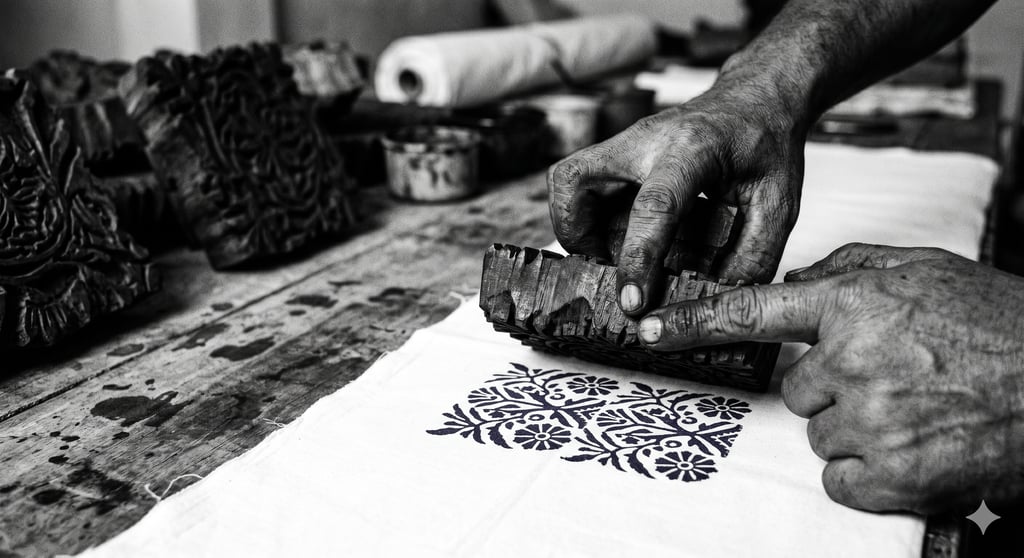
Block Print Clothing Manufacturing in Jaipur: The World's Finest Artisan Textile Hub
There is a neighbourhood in Jaipur called Sanganer. And there is a street in Sanganer that, on a Tuesday morning in January, smells of indigo, wet cotton, and something ancient and purposeful that has no name in English. On that street, artisans whose grandfathers taught their fathers who taught them are pressing hand-carved wooden blocks into lengths of white fabric, creating patterns that will end up on a boutique clothing rail in London, Melbourne, or New York — sold at prices that reflect the decades of skill embedded in every impression.
This is what block print clothing manufacturing in India actually is. Not a production technique — a living craft tradition. And for global fashion brands that understand that story sells, there is nowhere on earth that produces what Jaipur produces.
This guide covers the complete picture: the history, the production process, the business case for sourcing block print garments from Jaipur, and how to find a manufacturer who is doing this work with the integrity the craft deserves.
The History of Jaipur Block Printing: 400 Years in Two Minutes
Block printing arrived in Rajasthan with the Mughal court in the 16th century — a collision of Persian geometric sophistication and indigenous Indian botanical patterns that produced something neither culture had alone. The artisan community of chhipas (block printers) established itself in Sanganer and Bagru, two towns near Jaipur, where water from the Saraswati river was especially suited to the washing and mordanting processes that fix natural dyes into cotton.
By the 18th century, Jaipur block print fabrics were being exported to Europe — traded through the East India Company to dress rooms in English country houses and Parisian fashion salons. The irony is not lost on us that today, UK and French brands source the same craft from the same artisans for the same reason: it is simply the finest hand-printed textile in the world.
The craft survived industrialisation because machine printing cannot replicate what block printing produces. The slight registration variations, the depth of colour absorption into natural fibre, the tactile quality of the print surface — these are features, not manufacturing tolerances. They are what make a block-printed garment valuable rather than merely coloured.
How Hand Block Print Clothing Is Made: The Complete Process
Block Carving
Each unique pattern begins with a hand-carved wooden block — typically teak or sheesham wood for durability. A skilled block carver uses chisels, gouges, and files to cut the design into the wood surface, working from a pattern drawn by the designer or provided in a vector file. Intricate designs may use multiple blocks for different elements (outline, fill, secondary motifs). Block carving for a complex design takes 3–8 days per block. This is a skill with a 10–15 year learning curve — master block carvers are irreplaceable artisans.
Fabric Preparation
Natural fabric (cotton, linen, silk, or viscose) is washed to remove sizing chemicals (a process called desizing), then mordanted — treated with a mineral salt that opens the fibre structure to accept and bond with dye. The mordant determines colour depth and wash fastness. Alum mordant produces clear, bright colours; iron mordant creates darker, earthier tones. The fabric is then dampened and stretched on a long printing table covered with thick padding and a canvas cover.
Colour Mixing
Dye paste is mixed to specification — either synthetic AZO-free pigments matched to Pantone references, or natural plant-based dyes prepared from botanical sources. The paste is spread in a thin, even layer in a flat tray. Natural dyes require additional mordant in the paste and careful temperature management to maintain consistency. Every batch is tested on a swatch of the production fabric before printing begins.
Hand Printing
The printer positions the first block at the start of the fabric, pressing it into the dye tray and then firmly and evenly onto the cloth. Each impression is made with the same pressure, the same angle, the same care — repeated across the length of the fabric in a perfect (or intentionally imperfect) repeat. Multi-colour designs require a separate pass for each colour, with precise registration between prints. A skilled printer working on a complex multi-colour design produces approximately 10–15 metres of fabric per hour.
Drying and Curing
Printed fabric is dried in sunlight (preferred for natural dyes) or in temperature-controlled rooms for synthetic pigments. After drying, the fabric undergoes a curing or steaming process to set the dye permanently into the fibre structure. Natural-dyed fabrics typically require multiple wash stages to remove excess dye and ensure wash fastness.
Garment Construction
Printed fabric is cut according to the garment patterns and sewn by skilled seamstresses. For block-printed garments, pattern matching at seams is particularly important — a quality block print manufacturer aligns the print across seam lines wherever possible, which requires careful fabric positioning during cutting. This attention to print continuity is a marker of manufacturing quality that separates serious producers from commodity operations.
Finishing and Quality Control
Completed garments undergo finishing (pressing, trimming loose threads, and button attachment), followed by quality inspection. For block print specifically, QC includes: print coverage consistency, colour accuracy versus the approved sample, absence of unintended smudging, and seam print alignment. Finished garments are tagged, packed according to brand specifications, and prepared for export.
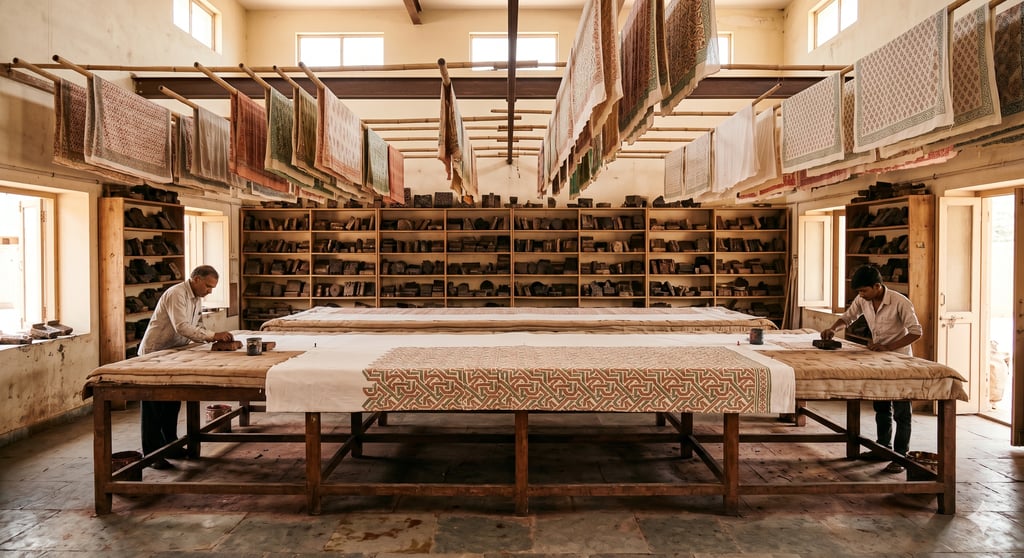
Types of Block Printing: Which Is Right for Your Brand?
Jaipur produces several distinct block printing traditions, each with its own aesthetic and production characteristics:
Sanganer Block Print
The most refined tradition — characterised by fine-line floral patterns, intricate geometric fills, and delicate colour palettes (often pastels on white). Sanganer printing was historically associated with court textiles and remains the most technically demanding style. Best suited for luxury positioning, resort wear, and feminine lifestyle collections.
Bagru Block Print
A more rustic, earthen tradition using traditional natural dyes (particularly dabu mud-resist printing). Colours are naturally derived — deep indigos, brick reds, ochres — and the aesthetic is deliberately imperfect and organic. Perfect for sustainable, slow-fashion, or boho-positioned brands. The dabu technique, where clay resist is applied before dyeing to create negative-space patterns, is unique to Bagru and produces effects impossible to achieve by any other method.
Contemporary Block Print
Traditional techniques applied to modern pattern design — geometric abstractions, large-scale motifs, editorial colour combinations. This hybrid approach is what most of Ashanari's brand clients are working with: the authenticity of hand-block production with design direction that speaks to contemporary markets in London, New York, and Melbourne.
200+
Artisan families in Sanganer block print
15m
Printed fabric per skilled printer / day
3–8
Days to carve a complex block
50+
Countries receive Jaipur block print exports
Why Global Brands Source Block Print from Jaipur — And Why Others Should
The business case for block print is more than aesthetic. Here's why it works commercially for fashion brands in the UK, USA, Australia, and Europe:
Premium Retail Positioning
Block-printed garments carry an inherent premium — consumers understand they're purchasing something made by human hands, not a machine. Retail price premiums of 20–40% over comparable digitally printed garments are achievable for brands who communicate the craft story clearly. The material cost of hand block printing (fabric + artisan labour) is higher than digital printing, but the retail premium more than compensates at the margin level that premium fashion operates in.
Differentiation That Can't Be Copied
An algorithm can't replicate hand block printing. A Bangladeshi volume factory can't produce it. A Chinese commodity manufacturer won't take the time for it. In a fashion market saturated with digitally-printed "artisan-aesthetic" imposters, actual hand block printing from Jaipur is genuinely distinctive — a moat that no fast fashion brand can bridge.
Sustainability Credentials
For sustainable brands, block printing with natural or AZO-free dyes on organic cotton is the most credible production story in global fashion manufacturing. Every element — the craft, the material, the human scale, the chemical profile — aligns with what sustainability-minded consumers in all five of our target markets reward with their purchasing decisions.
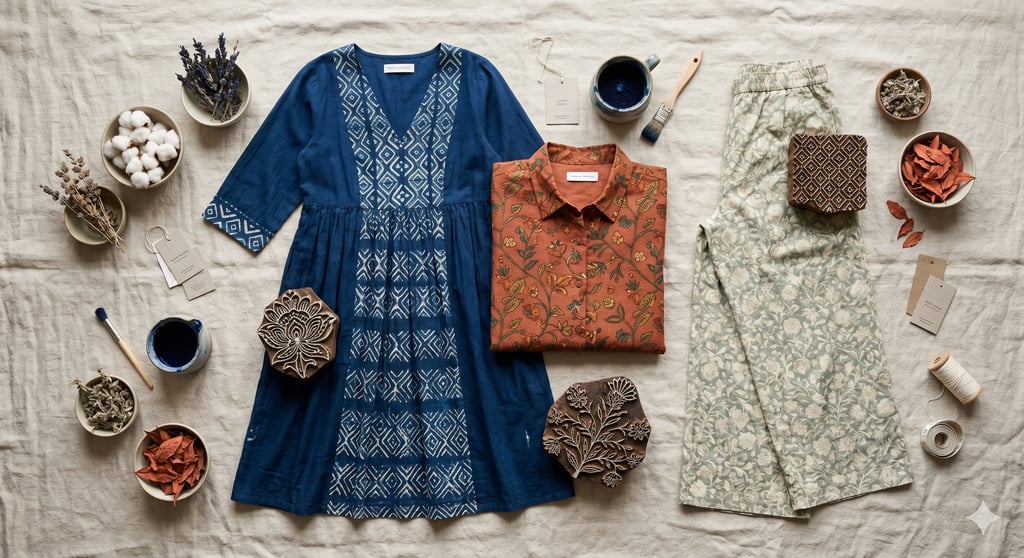
Bring Your Block Print Vision to Jaipur
Share your design concept — pattern direction, colour palette, garment types, and quantities. Our in-house design and production team will work with you to develop a collection that combines your brand aesthetic with Jaipur's finest craft tradition.
How to Source Block Print Clothing from India: What to Look For
The quality range among Jaipur block print manufacturers is wide. Here's how to evaluate a prospective partner:
✓ In-house printing: Confirm they print on-site, not at a subcontracted printing unit. In-house printing means quality control and communication are under one roof.
✓ Block carving capability or established block library: Manufacturers with their own block carvers can create custom designs. Those with only a pre-made block library will limit your design options.
✓ Natural dye option: If sustainability is important to your brand, confirm they can work with natural dyes — not all block print manufacturers offer this capability.
✓ Physical samples before bulk: Block print quality varies significantly between runs. Always sample — and sample specifically the colour matching accuracy, print registration, and wash fastness of the print.
⚠ Watch for digital-print imitation: Some manufacturers offer "block print look" digital prints that are significantly cheaper and faster to produce. If authentic hand block printing is your brand proposition, request a video of your specific fabric being printed.
Ashanari's block printing is entirely in-house — our artisans work in our Jaipur production facility, and we can provide video documentation of your specific order being printed before it ships. Our guide on hand block printing vs digital printing for clothing brands helps you decide which technique best serves your specific design and market. For fabric wholesale sourcing, see our guide on sourcing block print fabric wholesale from Jaipur.
Working with Ashanari for Block Print Clothing Manufacturing
Ashanari is a Jaipur-based B2B clothing manufacturer with in-house block printing. What that means in practice: you work with a manufacturer who actually makes the thing they're selling you. Our block printers are full-time members of our team, not subcontractors hired by the run. Our handcrafted manufacturing services include custom block design, both Sanganer and Bagru traditions, natural and AZO-free synthetic dye options, and block-print garment production with a low MOQ of 50 units per style.
Request a Block Print Sample Pack
We'll send you a curated selection of our current block print fabrics and garment samples — shipped to your door in the UK, USA, Australia, or Europe. See and feel the quality before you commit to production.
Contact
Reach out for custom orders or questions
call | Whatsapp | email
ashanariindia@gmail.com
Nitin +91-9351612343
Deepti +91-9549123654
Address:
Ashanari Pvt. Ltd.
A-68, Vidhyut Nagar, Ajmer Road, Jaipur,
Rajasthan, India -302021
© 2018. All rights reserved by Ashanari Pvt. Ltd
info@ashanari.com