
Clothing Tech Pack & Sampling Service India | Ashanari Guide
Tech packs, garment sampling and fabric sourcing in India — how each stage works, what it costs, and how to move from design concept to production-ready garments with an Indian manufacturer. Clothing Tech Pack Service India.
PRODUCTION ESSENTIALS
Ashanari
5/9/20266 min read
Clothing Tech Packs, Sampling and Fabric Sourcing in India: A Brand Owner's Complete Playbook
Between your design idea and a finished garment hanging in your stockroom, three things have to go right: your manufacturer understands exactly what you want (tech pack), they prove they can make it (sampling), and the materials you've agreed on are actually what gets used (fabric sourcing). These three stages — tech pack, sampling, fabric — are where most first-time brand founders lose time, money, and occasionally their entire first season.
This guide is the complete operational playbook for all three. Whether you're working with an Indian manufacturer for the first time or you're an experienced brand looking to tighten your pre-production process, this is the single reference you need.
Part One: The Tech Pack — What It Is and Why It Determines Everything
Direct Answer — "What is a clothing tech pack?"
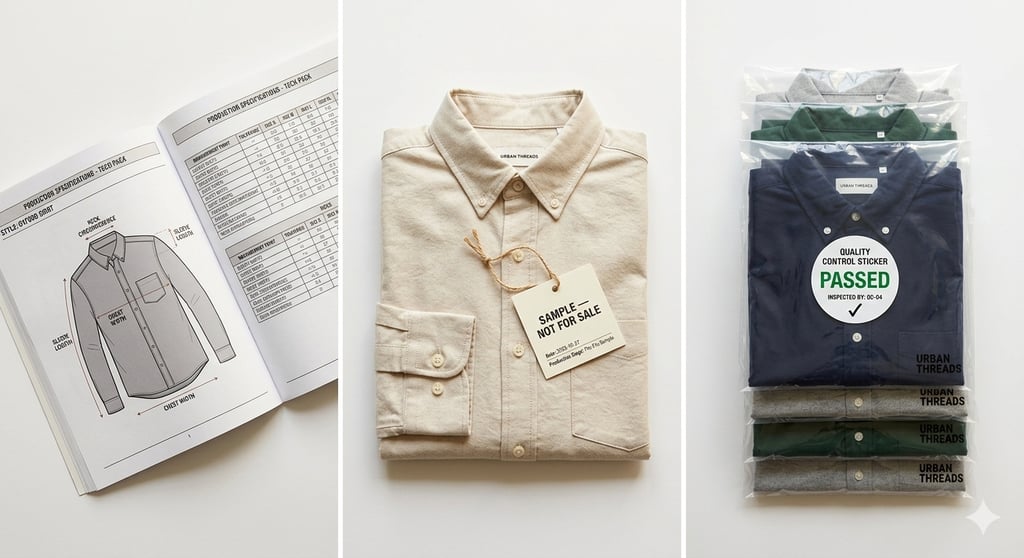
A clothing tech pack (technical package) is a complete specification document that tells a manufacturer exactly how to produce a garment. It includes flat technical sketches, a graded measurement chart, fabric and trim specifications, colour references, construction details, label placement, and packaging requirements. Without it, your manufacturer is interpreting rather than executing.
The Problem with Incomplete Tech Packs
Every unclear element of a tech pack becomes a manufacturer's decision. And a manufacturer making decisions about your design is a manufacturer guessing at your intentions. A garment with 12 unclear specifications will cost you 12 rounds of back-and-forth, 6 additional sampling iterations, and approximately 3 weeks of delays. In a seasonal business with a product launch date, those weeks matter.
What a Complete Tech Pack Contains
Front and back flat sketch: Technical (not fashion illustration) drawings showing exact proportions, seam lines, pocket detail, closure position
Measurement spec sheet: Every critical point of measure across your full size run (XS–XL or EU 34–44), graded in 0.5cm increments with tolerance allowances
Fabric BOM (Bill of Materials): Fabric type, composition, weight in GSM, weave structure, finish, and either a supplier reference or a clear swatch
Colour specification: Pantone PMS codes for all elements — body, thread, print, labels
Construction notes: Stitch type and count per inch, seam allowances, hem construction, interfacing specification
Surface treatment detail: For print or embroidery — artwork file (vector), placement measurements, colour codes, technique specification
Trims list: Every button, zip, elastic, and fastening with size, material, colour, and supplier if specified
Label spec: Brand woven label size and placement, care label content (REACH/EU or UK/US standard), hangtag attachment
Packaging spec: Folding method, polybag size, carton quantity, packing list format
What to Do If You Can't Create a Tech Pack
Three viable options, in order of cost:
Hire a freelance technical designer on Upwork or Fiverr — budget £150–£500 per style. For EU-based founders, German and Dutch freelancers on these platforms often have strong fashion tech backgrounds.
Use tech pack software — Techpacker (cloud-based, intuitive), Audaces (common in European fashion), or even structured Google Slides templates available from fashion design communities.
Use your manufacturer's pre-production service — Ashanari offers tech pack development as part of our pre-production support services. We work from your sketches, reference garments, and brief to build the technical document collaboratively. This is the most efficient option for founders without technical design backgrounds.
67%
First-order sampling issues trace to incomplete tech packs
1–2
Sampling rounds with a complete tech pack (typical)
3–5
Sampling rounds without one (typical)
£150–£500
Freelance tech pack cost per style
Part Two: Garment Sampling — How It Actually Works in India
Direct Answer — "How does garment sampling work in India?"
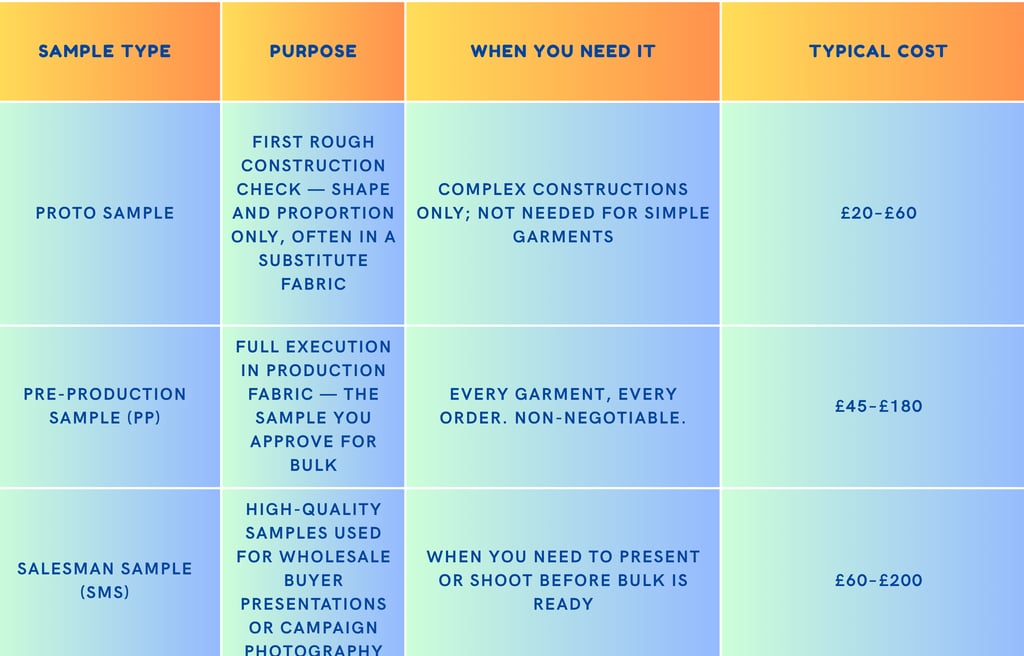
Garment sampling in India is the process of producing one or more physical trial garments before bulk production begins. The manufacturer uses your tech pack and approved fabric to make a prototype. You evaluate this sample against your specification, request revisions if needed, and approve it only when it matches your standard. Bulk production begins only after written sample approval.
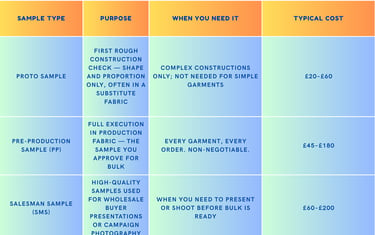
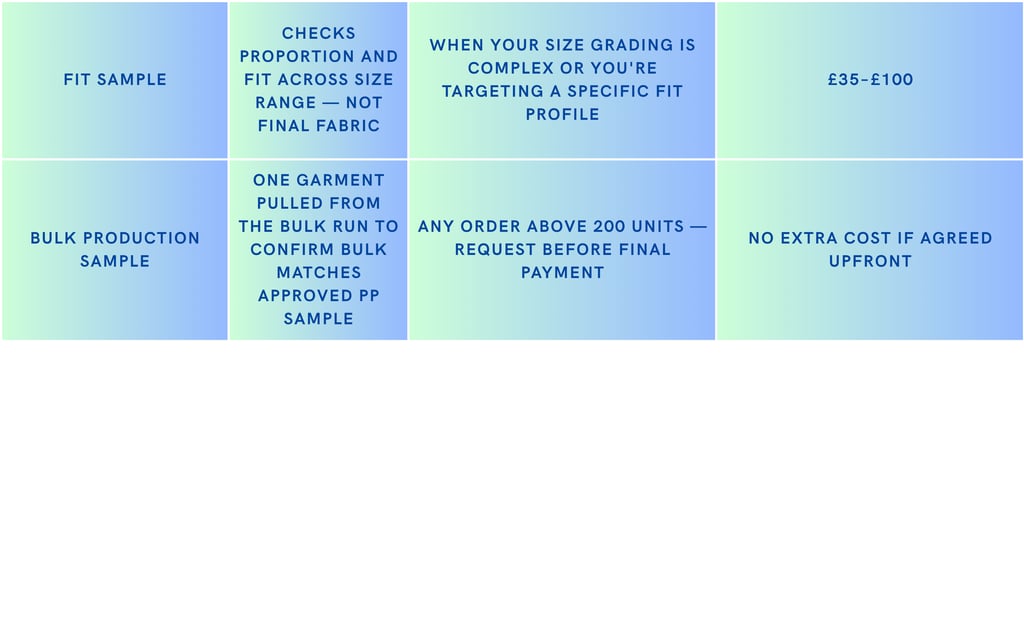
The Different Sample Types — And Which You Actually Need
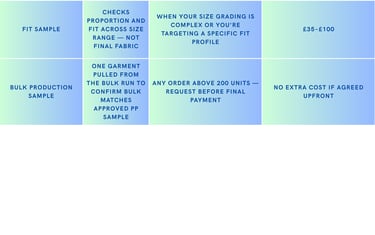
How Long Does Sampling Take?
For a woven garment from a Jaipur manufacturer: 10–18 days from confirmed tech pack to sample dispatch. Add 4–7 days for international shipping to Europe, UK, Australia, or the USA. Total time from tech pack approval to sample in your hands: 14–25 days. For embroidered or block-printed garments with complex surface treatments: 18–28 days production, plus shipping.
What to Check When Your Sample Arrives
✓Measure every critical point against your spec sheet — don't guess, measure. Chest, waist, hip, length, sleeve, shoulder, armhole. Record deviations.
✓Check the fabric hand-feel and weight against your approved swatch. Run your hands over it, hold it up to light, check the weave.
✓Try it on a real body or a dress form close to your target customer's measurements. Flat measurement accuracy doesn't guarantee good fit.
✓Inspect every seam under direct light — 10 stitches per inch is your minimum for most woven garments. Check underarm seams, pocket openings, and waistband attachment.
✓For print or embroidery: check colour accuracy versus your Pantone reference in both natural and artificial light. Check placement measurements against the spec.
✓Wash the sample (following intended care instructions) and re-evaluate after washing. Does colour bleed? Does it shrink beyond specification? Does the print hold?
⚠Never approve a sample you're uncertain about to "save time." The uncertainty doesn't disappear in bulk production — it multiplies across every unit.
Writing Effective Revision Notes
When requesting revisions, specificity is everything. Compare:
Ineffective: "The shoulder area doesn't feel right." — the manufacturer cannot address this.
Effective: "The shoulder seam sits 1.5cm too far toward the front. Please shift the shoulder seam placement 1.5cm toward the back, and reduce shoulder width by 0.5cm on each side." — The manufacturer can execute this precisely.
Part Three: Fabric Sourcing in India — What's Available and How to Access It
Direct Answer — "What fabrics can I source from India for my clothing brand?"
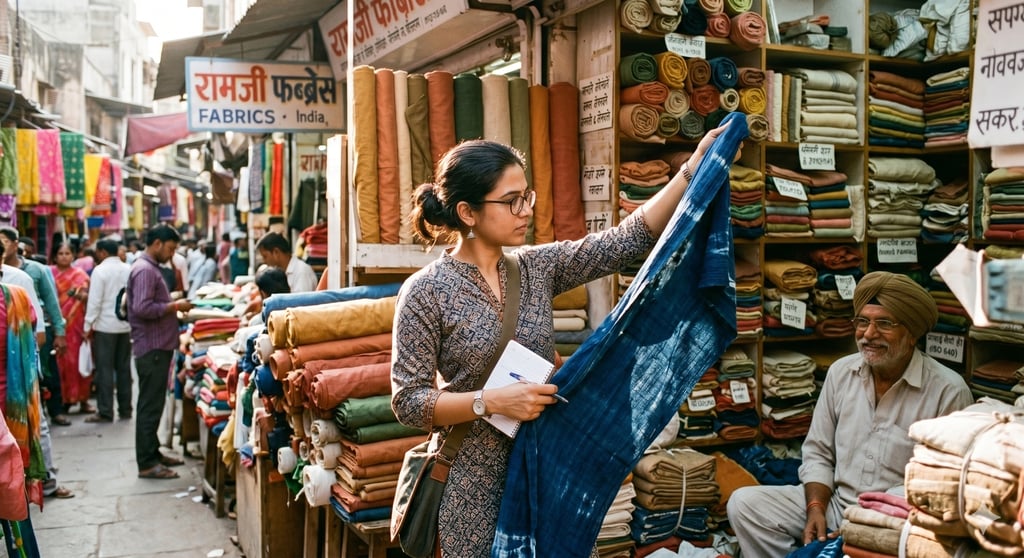
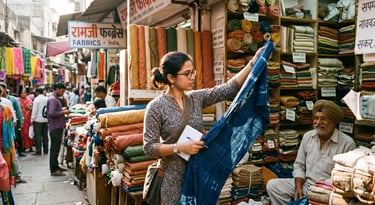
India offers one of the world's most diverse fabric supply chains: GOTS-certified organic cotton, handloom cotton and linen, chanderi silk blends, viscose/rayon in multiple weights, raw silk, block-print-ready cotton voile, and hand-dyed natural fibre fabrics. Most are available through Jaipur fabric markets or sourced by your manufacturer directly from regional mills.
Jaipur's Fabric Sourcing Ecosystem
Jaipur manufacturers typically source fabric through three channels:
Local wholesale fabric markets (Bapu Bazaar, Johari Bazaar) — hundreds of fabric traders stocking standard and specialty textiles. Competitive pricing; immediate availability for standard fabrics. Good for: cotton voile, poplin, linen, viscose, khadi.
Regional mill partnerships — direct relationships with mills in Rajasthan, Gujarat, and Madhya Pradesh for specific fabric types. Better for consistent quality across seasons and organic certified fabrics. Good for: GOTS cotton, organic linen, specialist handloom.
Specialist artisan fabric producers — working directly with block printers, natural dyers, and handloom weavers to produce fabric that is itself the craft product. Unique to the Indian manufacturing ecosystem. Good for: hand block-printed fabric, dabu-resist fabric, natural-dyed cloth.
Requesting Fabric Swatches: What to Ask For
When requesting fabric samples from your manufacturer, always specify:
Fabric type and composition (e.g., "100% organic cotton poplin")
Weight in GSM (e.g., "130–150 GSM")
Weave structure (plain, twill, satin, dobby)
Finish requirement (washed, unwashed, mercerised, brushed)
Colour direction (Pantone code or "natural undyed")
Minimum number of swatches (request 3–4 options, not just one)
EU and UK Specific: Fabric Compliance Requirements
For European brands, fabrics must comply with EU REACH regulations — specifically Annex XVII restrictions on certain dyes and finishes. Request an OEKO-TEX Standard 100 test report or REACH compliance documentation from your fabric mill for any European market sale. UK brands post-Brexit should reference UK REACH requirements (mirroring EU REACH at time of writing). A reputable Indian manufacturer will have these documents readily available for their standard fabric range.
Get Your Pre-Production Right the First Time
Ashanari offers end-to-end pre-production support: tech pack development, fabric sourcing with swatch delivery, pre-production sampling, and revision management — all from one Jaipur-based team you communicate with directly. Most first-time clients move from initial brief to approved sample within 30 days. Let's start yours.
The Pre-Production Timeline in Numbers
To summarise the complete pre-production journey from brief to bulk production approval:
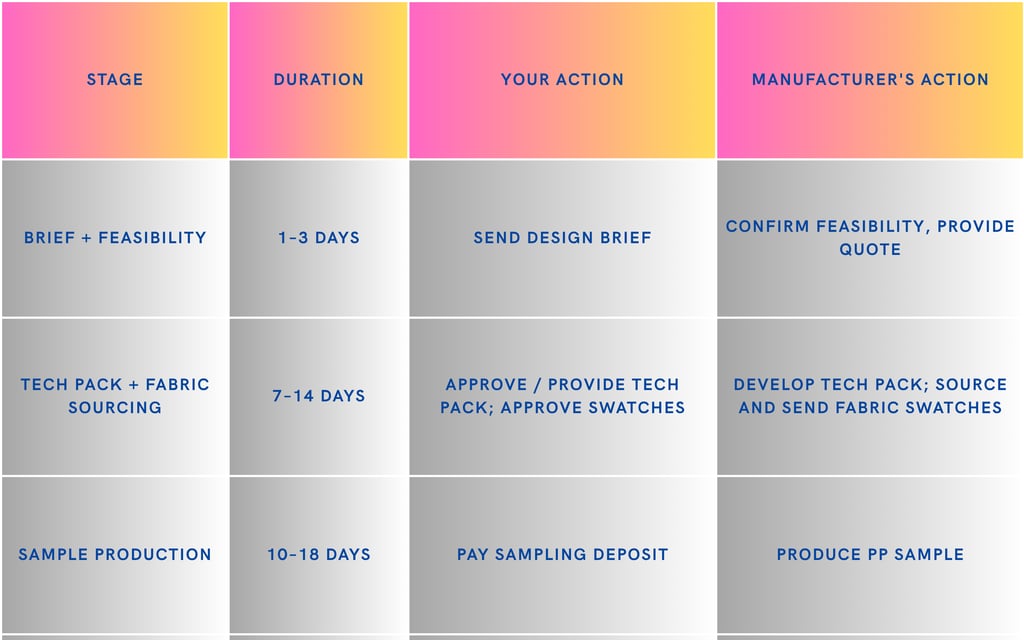
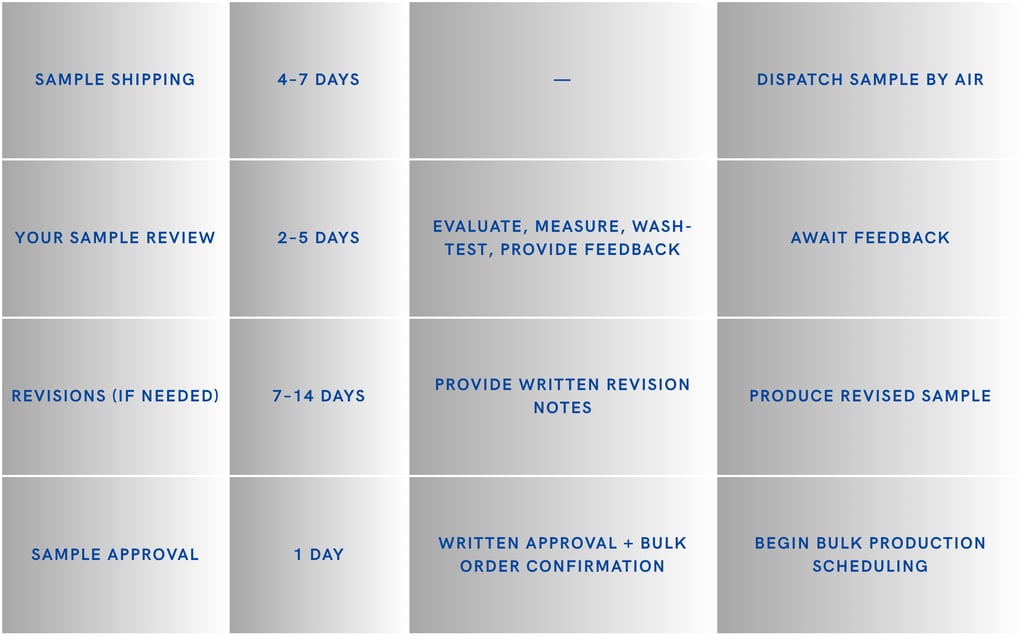
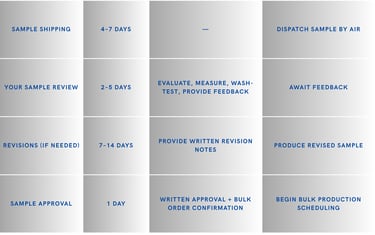
Total Pre-Production32–62 daysShorter for brands with complete tech packs and fast decision-making
After pre-production approval, bulk production takes a further 25–45 days. Read our full custom apparel manufacturing guide for the complete production-to-delivery picture, or our tech pack creation guide if you're still building your initial documentation.
Don't Know Where to Start With Pre-Production?
Many of the brands we work with arrive at their first conversation with a great design idea and no technical documentation whatsoever. That's fine. Tell us what you want to make, share your references, and we'll walk you through exactly what we need and build the rest together. The first conversation costs nothing.
Contact
Reach out for custom orders or questions
call | Whatsapp | email
ashanariindia@gmail.com
Nitin +91-9351612343
Deepti +91-9549123654
Address:
Ashanari Pvt. Ltd.
A-68, Vidhyut Nagar, Ajmer Road, Jaipur,
Rajasthan, India -302021
© 2025. All rights reserved with ashanari pvt ltd
info@ashanari.com