

Custom Apparel Manufacturer India | From Concept to Garment
How does a custom apparel manufacturer india work? From your first sketch to a finished garment — a complete guide covering process, costs, timelines, and what to expect at each stage.
MANUFACTURING GUIDES
Manufacturing Guides
5/2/20267 min read
Custom Apparel Manufacturing in India: From Concept to Finished Garment (2025 Complete Guide)
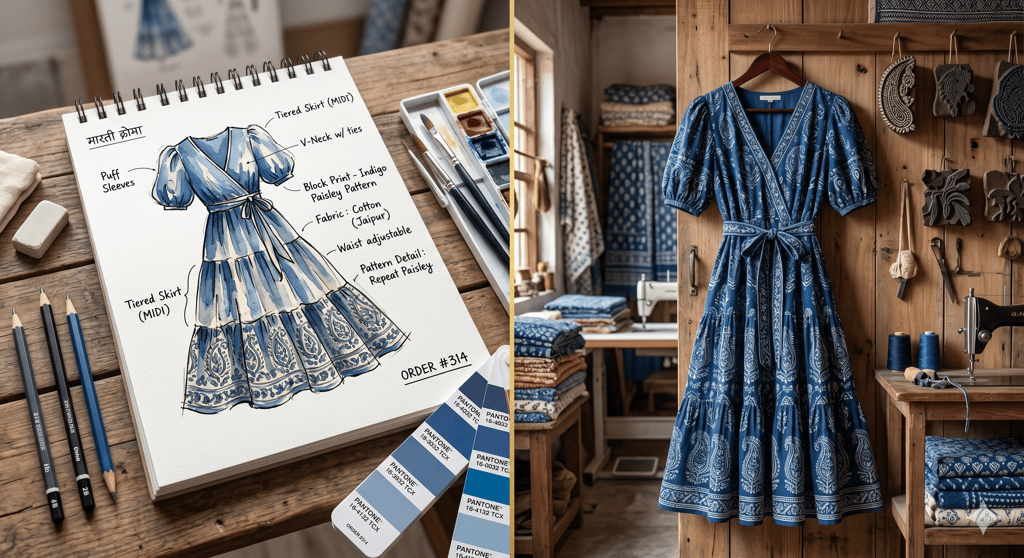
Custom apparel manufacturing is the process of producing clothing built entirely to your specifications — your design, your fabric, your construction details, your label. Nothing is taken off a shelf or adapted from someone else's template. Every stitch exists because you decided it should.
For brand founders across Europe, the UK, Australia, and the United States, India — and specifically Jaipur — has become the answer to the custom manufacturing question. Not because it's cheap (though the economics are genuinely compelling), but because no other manufacturing hub combines craft depth, material variety, and production flexibility the way Jaipur's garment ecosystem does.
This guide walks you through the complete custom apparel manufacturing process in India: what happens at each stage, what decisions you make, what things cost, and what to expect when working with a custom manufacturer for the first time.
Direct Answer — "What is custom apparel manufacturing?"
Custom apparel manufacturing means producing clothing made specifically to a brand's own design and specifications, using fabrics, construction techniques, and branding chosen by the brand — not the manufacturer. The brand owns the design; the manufacturer provides the production skills and infrastructure to make it real.
Custom Manufacturing vs Private Label vs White Label: What's the Difference?
These three terms get used interchangeably in fashion founder communities, but they describe different arrangements with meaningfully different implications for your brand:
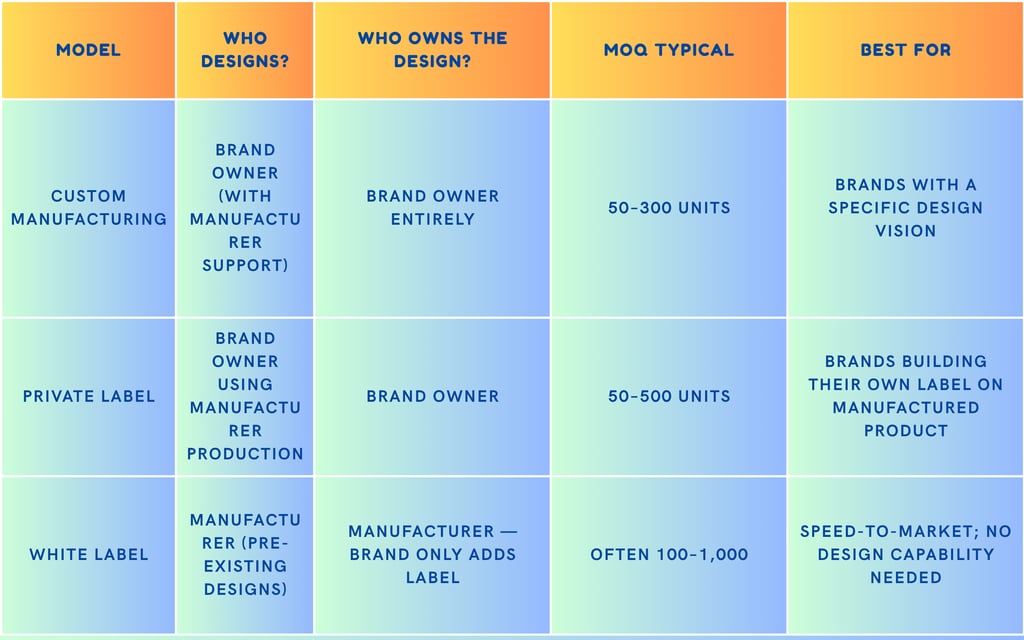
The distinction that matters for this guide: custom manufacturing means your design, made from scratch. You're not choosing from a catalogue. You're creating a garment that exists because you imagined it.
Why India for Custom Clothing Manufacturing?
The answer isn't simply cost — it's capability. India's manufacturing ecosystem provides three things that other major production countries don't simultaneously offer:
Design Collaboration at the Production Stage
Indian manufacturers — particularly in Jaipur — are accustomed to working with brand founders who have a visual concept but not a finished technical document. A skilled Indian manufacturer's production team can translate a mood board, sketch, and reference garments into a workable pattern and spec sheet, effectively providing design development services as part of the manufacturing relationship. This is rare in Chinese manufacturing (where factories expect complete tech packs) and prohibitively expensive in European manufacturing.
Material Depth You Can't Access Elsewhere
Jaipur's fabric markets — particularly the wholesale textile hubs of Johari Bazaar and Bapu Bazaar — stock fabrics that simply don't exist in comparable variety at competitive prices anywhere else in the world. Hand-woven cottons, organic linen, chanderi silk blends, aari embroidered fabric, dabu-dyed cloth, and handloom weaves sit alongside standard production materials. Your custom garment doesn't just get made — it gets made from materials with genuine provenance and visual distinction. Our guide on fabric sourcing in India covers this in full detail.
Artisan Craft Techniques as Standard Production Options
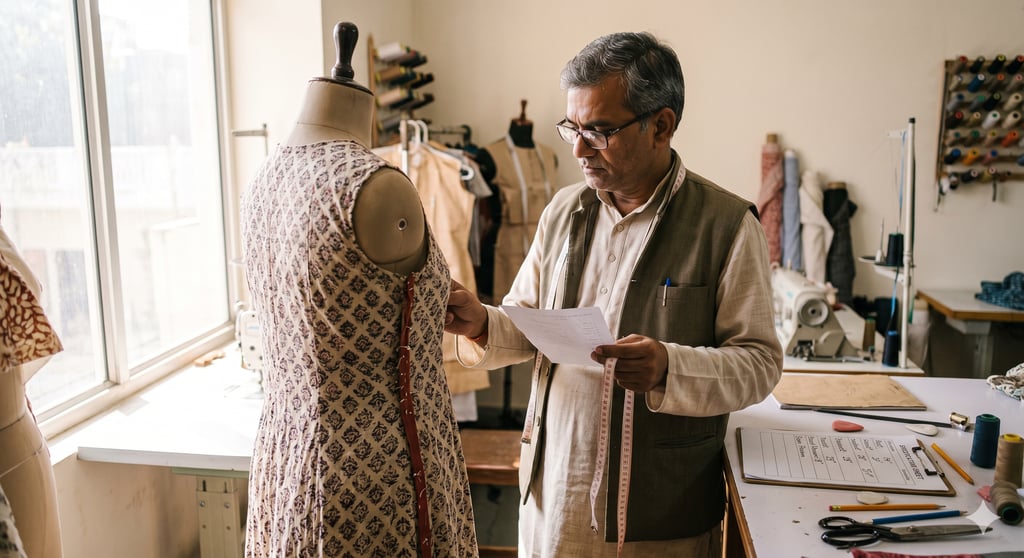
In most manufacturing countries, hand embroidery, block printing, and natural dyeing are specialty commissions that require finding specialist producers. In Jaipur, these are standard production services that custom manufacturers offer as part of their normal capability. A custom garment can incorporate hand-stitched embroidery, a block-printed panel, and a natural-dye finish — all from a single production partner. This is Jaipur's fundamental competitive advantage.
50
Min units per custom style (Ashanari)
30–50
Days: approved sample to delivery
40–60%
Cost saving vs EU domestic custom production
7
Artisan techniques available in-house at Ashanari
The Custom Apparel Manufacturing Process: Every Stage Explained
Concept Brief — What You Send First
Your initial communication with a custom manufacturer should include: design sketches or reference images, fabric preferences (type, weight, fibre), approximate measurements or size range, colour direction (Pantone codes or physical swatches), any surface treatment requirements (embroidery, print, dye technique), target quantity, and your timeline. You don't need a finished tech pack at this stage — a clear brief is enough to get an initial feasibility response and an indicative quote within 48 hours from a professional manufacturer.
2. Feasibility Check and Initial Quote
A competent custom manufacturer will review your brief and come back with: confirmation of production feasibility, fabric sourcing options and indicative fabric cost, CMT (Cut, Make, Trim) estimate, total per-unit cost range, timeline estimate, and their required next steps. If any element of your brief is outside their capability, an honest manufacturer tells you at this stage rather than taking the order and discovering the problem mid-production.
3. Tech Pack Development (If Required)
Once you agree to proceed, a formal tech pack is developed — either by you (with a freelance technical designer), or by the manufacturer as part of their pre-production services. The tech pack translates your concept into manufacturer-executable specifications: flat sketches, measurement charts, material BOM, construction details, print/embroidery placement, and label requirements. This stage takes 5–14 days, depending on complexity. For manufacturers like Ashanari who offer tech pack support, this stage happens in collaboration — not in isolation.
Fabric Sourcing and Approval
The manufacturer sources fabric samples matching your specification and sends swatches for your approval. This is a critical decision point: fabric choice affects the garment's hand-feel, drape, wash behaviour, and production cost. Request physical swatches (not photos) before approving fabric. Approve only what you've physically handled. The time to discover a fabric feels different from what you expected is before 100 metres of it are cut.
Pre-Production Sample (PP Sample)
The manufacturer produces 1–2 physical samples of each garment. This is the single most important step in the entire process. The PP sample is your opportunity to verify fit, construction quality, material accuracy, and colour before bulk production commits resources. Evaluate it on a real body (not just lying flat). Check every seam, every detail, every measurement against your spec. Request revisions clearly and in writing — "the neckline runs 2cm too low; please raise" is actionable. "Something feels off" is not.
Sample Approval and Bulk Production
Once you approve the sample (in writing), bulk production begins. Your manufacturer should provide a production schedule showing key milestones: fabric cutting date, sewing completion, finishing and QC, packing, and dispatch. Request progress photos at cutting and sewing stages — not as a trust exercise, but as an early warning for any deviations from the approved sample before the entire run is complete.
Quality Control and Dispatch
End-of-line quality control involves measuring a statistical sample of the bulk production against the approved spec, checking for workmanship defects (loose threads, skipped stitches, print smudging, misaligned embroidery), and confirming packaging meets your specification. The manufacturer dispatches with complete export documentation: commercial invoice, packing list, certificate of origin, and airway bill or bill of lading. Your goods are on their way to London, Berlin, Sydney, or New York.
Realistic Timelines for Custom Clothing Manufacturing in India
Days 1–3
Brief, Feasibility Response & Initial Quote
You send your concept brief. The manufacturer confirms feasibility, asks clarifying questions, and provides an indicative cost estimate within 48–72 hours.
Days 4–14
Tech Pack Development & Fabric Sourcing
The tech pack is finalised (either by you or collaboratively with the manufacturer). Fabric swatches are sourced and sent for your approval. You pay the sampling deposit (typically 50–100% of the sample cost).
Days 15–28
Sample Production & Shipping
Samples are produced and shipped to you by air. International sample delivery typically takes 4–7 days once dispatched. You receive, evaluate, and provide revision feedback.
Days 29–35
Sample Revisions (If Any) & Approval
A second round of samples is produced if revisions are needed. Most professional manufacturers complete revisions within 7–10 days of receiving feedback. You approve and confirm the bulk order.
Days 36–65
Bulk Production
Bulk production runs 25–45 days, depending on quantity, construction complexity, and artisan technique requirements. You pay the production deposit (30–40%) at order confirmation.
Days 66–75
QC, Packing & Dispatch
Final quality inspection, packing to specification, and export documentation. Air freight to Europe, UK, or Australia: 4–7 days. Sea freight: 18–30 days depending on destination.
Total timeline from first brief to goods in hand: 70–90 days for a first order with revisions. Brands that come with a complete tech pack and make fast sample decisions routinely complete their first custom order in 55–65 days.
What Custom Apparel Manufacturing Actually Costs in India
Custom manufacturing costs more per unit than buying from a pre-existing range — because it involves design development, pattern making, and often specialist materials. Here's a realistic breakdown for a custom woven dress, produced in Jaipur, at 100 units:
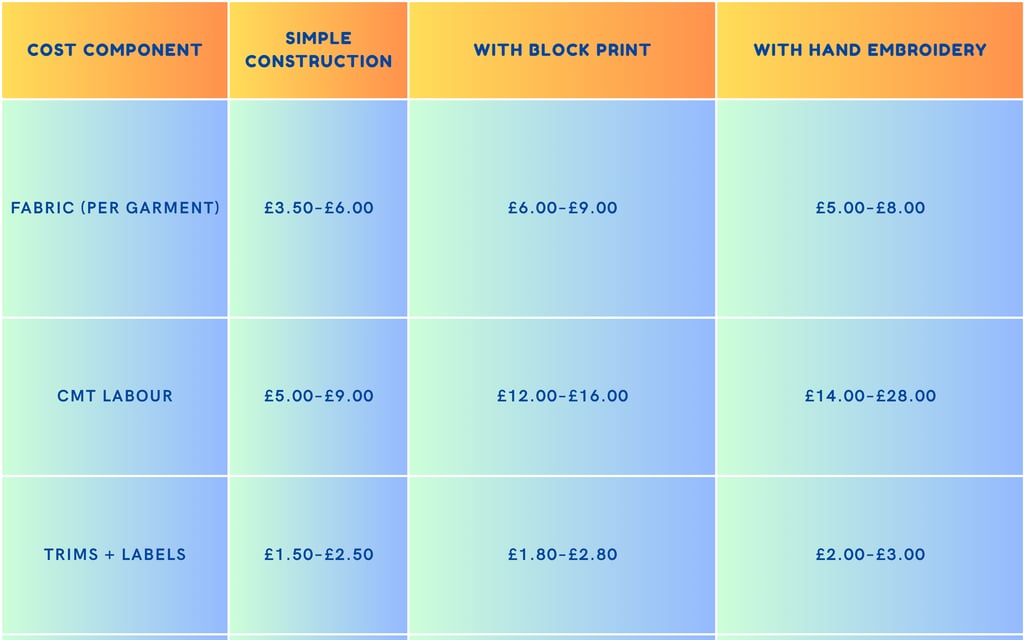
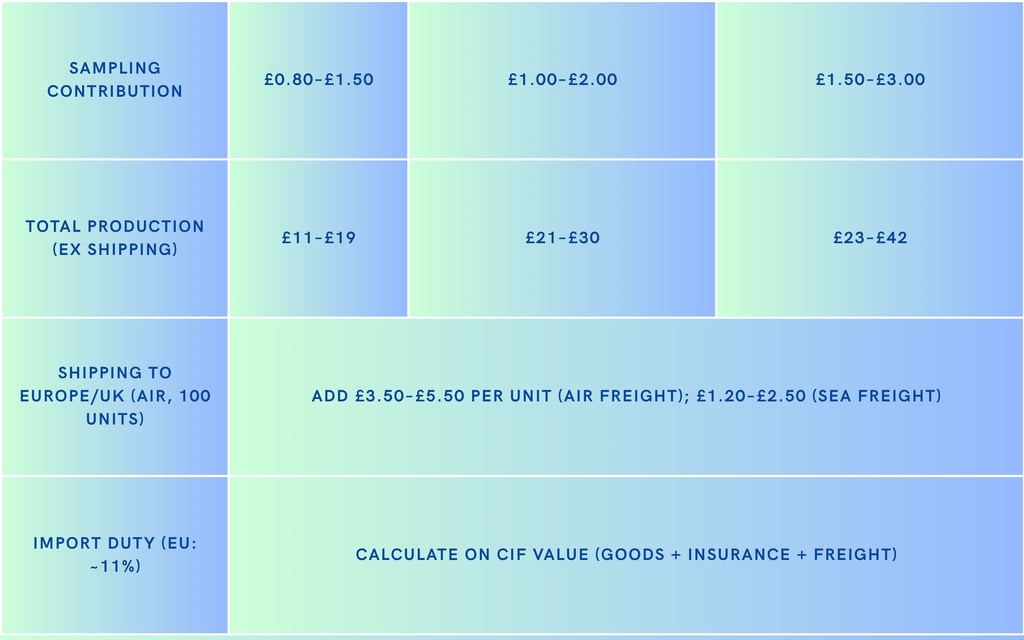
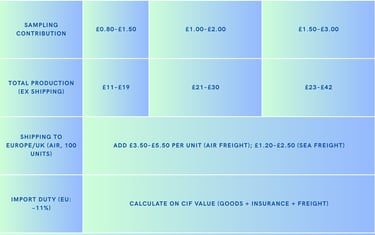
A custom block-printed dress landing in Germany at £27–£38 total cost can realistically retail at €120–€180 — a healthy margin for an independent European label. For a detailed cost breakdown across garment types, read our 2025 India manufacturing cost guide.
Questions Founders Often Ask About Custom Manufacturing
Can I do custom clothing manufacturing if I don't have a tech pack?
Yes — though the process takes longer and involves more back-and-forth during sampling. A manufacturer like Ashanari can work from detailed sketches, reference garments, and written specifications, then develop the technical documentation in-house. If you want to create your own tech pack, read our guide on what a tech pack contains and how to build one.
What is the minimum quantity for custom clothing manufacturing in India?
At Ashanari, 50 units per style. Some manufacturers require 100–200 per style for custom work. Quantities below 50 units are typically only viable if you accept a significant per-unit price premium, or if the design uses in-stock fabrics rather than specially sourced materials.
What is the difference between custom and bespoke clothing manufacturing?
In garment manufacturing terms, "custom" and "bespoke" are used almost interchangeably. Technically, "bespoke" implies a higher degree of individual tailoring (e.g., made-to-measure for a specific body), while "custom" typically refers to brand-specific design produced at small scale. In B2B manufacturing contexts, both terms mean: you specify the design, the manufacturer produces it.
How long does custom clothing manufacturing take in India?
First orders typically take 70–90 days from initial brief to delivery (including sampling). Reorders of approved styles, where sampling is complete and production can proceed directly, take 30–45 days production time plus shipping. Brands who have approved tech packs and established relationships with their manufacturer can place reorders and receive goods within 40–50 days to most international markets.
Ready to Turn Your Design Into a Real Garment?
Send us your concept — sketches, reference images, fabric ideas, or just a detailed written brief. Our Jaipur production team will assess feasibility, suggest materials, and provide an itemised quote within 48 hours. No vague estimates. No gatekeeping. Just a clear path from your idea to a finished garment your customers will love.
Once you understand the custom manufacturing process, the next step is understanding how to work with a manufacturer from first contact through to delivery. Read our detailed guide on how to work with a clothing manufacturer as a first-time brand founder — it covers every communication step, decision point, and common mistake in plain language.
Contact
Reach out for custom orders or questions
call | Whatsapp | email
ashanariindia@gmail.com
Nitin +91-9351612343
Deepti +91-9549123654
Address:
Ashanari Pvt. Ltd.
A-68, Vidhyut Nagar, Ajmer Road, Jaipur,
Rajasthan, India -302021
© 2025. All rights reserved with ashanari pvt ltd
info@ashanari.com