
Ethical Clothing Manufacturer India | What It Really Means
What does "ethical clothing manufacturer india" actually mean? Cut through the greenwashing and learn what to look for when sourcing from India for your fashion brand.
ETHICAL CLOTHING MANUFACTURER INDIA
Ashanari
4/8/20264 min read
What Does "Ethical Clothing Manufacturer" Actually Mean?
A Brand Owner's Honest Guide
"Ethical manufacturer." "Sustainable production." "Fair trade garments." These phrases appear in almost every manufacturer's pitch deck and almost no manufacturer's audit report. For brand owners who genuinely care about how their clothes are made — and increasingly, whose customers hold them accountable for it — the gap between marketing language and operational reality is where the most important decisions get made.
This guide cuts through the noise. Here's what ethical clothing manufacturing actually means, what to demand from your Indian supplier, and how to verify claims before you place your first order.
The Problem With "Ethical" as a Marketing Word
The fashion industry has a greenwashing problem. A manufacturer who pays workers above minimum wage, maintains clean facilities, and uses AZO-free dyes can legitimately describe themselves as "ethical" — but so can one who does none of these things and simply uses the word because it converts well in pitch emails.
Ethical clothing manufacturing isn't a single standard — it's a spectrum of practices across multiple dimensions: labour conditions, environmental impact, supply chain transparency, material sourcing, and wage fairness. Understanding which dimensions matter most for your brand — and which your customers will actually verify — is the first step to sourcing responsibly.
The Five Dimensions of Ethical Clothing Manufacturing
1. Fair Labour Practices
This is the dimension most consumers think of first. Ethical labour means: workers paid at or above the local living wage (not just minimum wage), reasonable working hours (no forced overtime), safe working conditions, no child labour, and freedom of association. In India, the legal minimum wage varies by state and skill level. A genuinely ethical manufacturer pays above this floor and can demonstrate it.
What to ask: "Can you provide your most recent wages register and production floor photos?" Legitimate manufacturers answer this immediately.
2. Environmental Practices
This includes dye wastewater management, use of AZO-free or natural dyes, water consumption, energy source, and waste management. Jaipur's block print industry has a complex history here: traditional natural-dye block printing is among the most environmentally gentle textile processes in the world, but some manufacturers have shifted to cheaper synthetic dyes without proper wastewater treatment.
What to ask: "What dyes do you use? Do you have an Effluent Treatment Plant?" GOTS (Global Organic Textile Standard) certification is the gold standard here.
3. Supply Chain Transparency
Do you know where your fabric comes from? Where the buttons were made? Who wove the lining? Full supply chain transparency — Tier 1 (the garment manufacturer), Tier 2 (fabric mill), and Tier 3 (raw material supplier) — is the goal of truly ethical brands. Most manufacturers can account for Tier 1. Fewer can account for Tier 2 and almost none for Tier 3.
What to ask: "Can you tell me where the fabrics for my order will come from?" A manufacturer who knows their fabric mills and can introduce you to them is a meaningful green flag.
4. Material Ethics
Organic cotton, TENCEL, recycled polyester, linen, and hemp all have significantly lower environmental impact than conventional cotton or virgin synthetics. Conventional cotton farming uses around 10,000 litres of water per kilogram — one of agriculture's most water-intensive crops. India's organic cotton sector, particularly in Gujarat and Maharashtra, is well-developed and GOTS-certified. Our guide on organic cotton clothing manufacturing in India goes deeper on this.
5. Artisan & Cultural Ethics
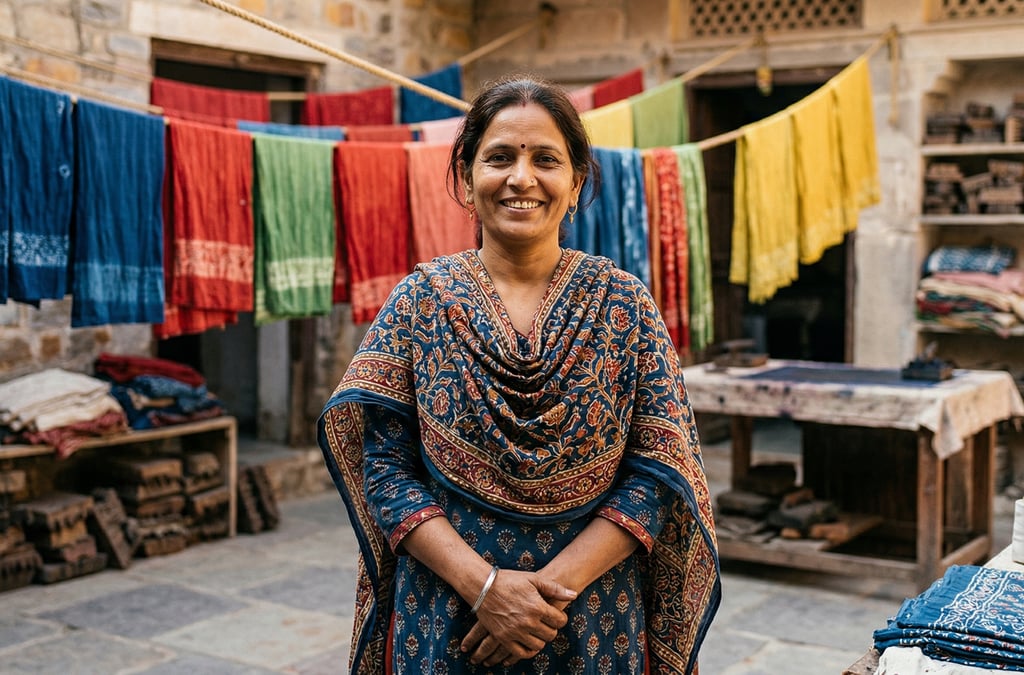
For brands sourcing handcraft — block printing, embroidery, handloom weaving — there's an additional ethical dimension: are the artisans paid fairly for their skilled labour? Is the craft being preserved or commodified? Jaipur's craft ecosystem is a genuine cultural asset. Manufacturers who pay artisans a living wage, credit their craft, and don't mass-produce block print as a meaningless marketing tick are genuinely ethical operators in a way that certifications can't fully capture.
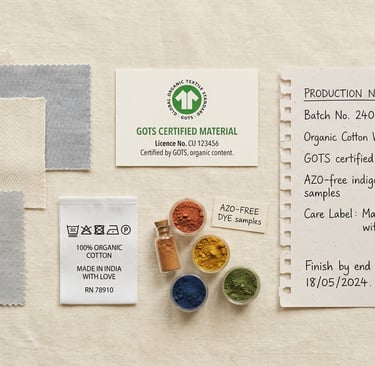
Certifications That Actually Matter (And Which Don't)
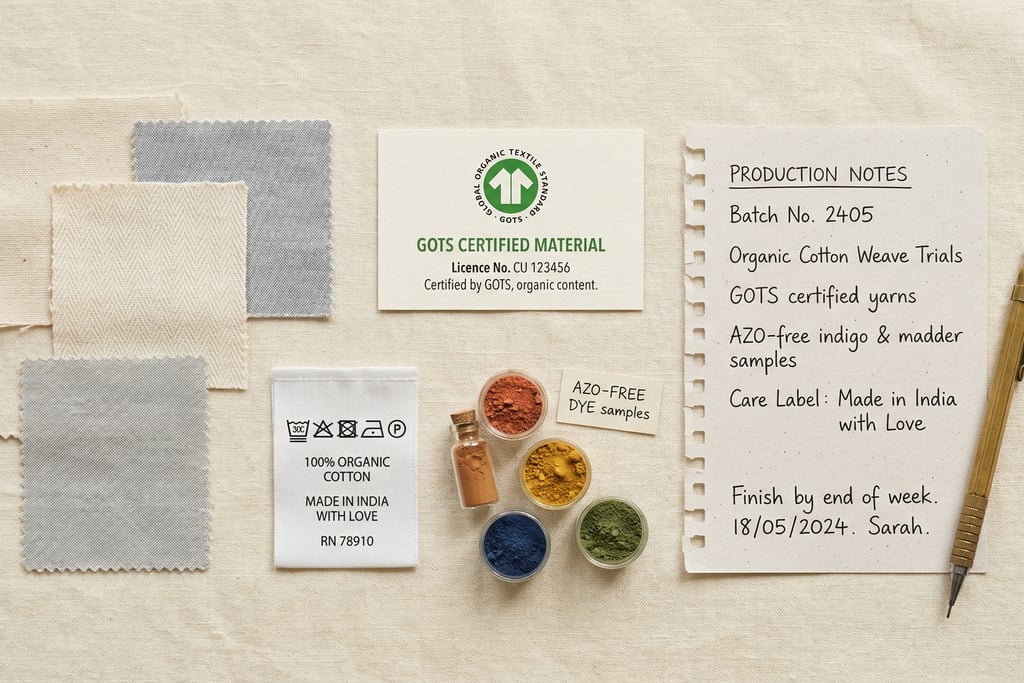
Certifications can be useful signposts, but they're not a substitute for direct verification.
GOTS (Global Organic Textile Standard): The most credible organic textile certification. Covers the full supply chain from raw material to finished product. Meaningful.
OEKO-TEX Standard 100: Tests for harmful substances in finished products. Useful for chemical safety; doesn't address labour practices.
SA8000: Labour conditions standard. Meaningful for workers' rights verification.
Fair Trade: Useful but primarily applicable to raw materials, not always to finished garment manufacturing.
Self-declared "eco" or "sustainable" badges: Meaningless without third-party verification.
How to Verify Ethical Claims Without a Factory Visit
Most brand founders launching internationally can't travel to India for a factory audit. Here's how to verify from a distance:
Request third-party audit reports (SMETA, SA8000, BSCI)
Ask for a video walkthrough of the production facility
Request payroll and wage records for a recent month
Check if the manufacturer has certifications verifiable on the certifying body's public database
Talk to other brands who have sourced from them — ask specifically about labour and environment
The most ethically reliable manufacturers are usually the most transparent. If a factory is reluctant to share any of the above, that reluctance is itself the answer.
Ashanari's Approach to Ethical Manufacturing
At Ashanari, we believe ethical manufacturing is non-negotiable — not because it's good marketing, but because it's the only way to build a supply chain we're proud of and that brands can stand behind.
Our practices include above-minimum-wage pay for all artisans, AZO-free dye use across our block printing operations, traceable fabric sourcing (we can tell you where every fabric comes from), no subcontracting of artisan work, and transparent production photo documentation throughout every order.
We're not perfect — no manufacturer is. But we're honest about where we are, what we're working on, and what we can guarantee. Visit our manufacturing services page for a full breakdown of how we work, or read our deeper guide on sustainable clothing manufacturing in India for the full picture.
Building an Ethical Fashion Brand?
Tell us about your values and your vision. We'll tell you honestly what we can deliver — and help you build a brand your customers will trust.
Contact
Reach out for custom orders or questions
call | Whatsapp | email
ashanariindia@gmail.com
Nitin +91-9351612343
Deepti +91-9549123654
Address:
Ashanari Pvt. Ltd.
A-68, Vidhyut Nagar, Ajmer Road, Jaipur,
Rajasthan, India -302021
© 2025. All rights reserved with ashanari pvt ltd
info@ashanari.com