
Fabric Sourcing India | International Buyer's Guide 2025
How fabric sourcing in India works for international clothing brands. Jaipur's textile markets, fabric types, quality checking, and how your manufacturer sources on your behalf.
MANUFACTURING GUIDES
Ashanari sourcing team
7/18/20266 min read
Fabric Sourcing in India: The International Buyer's Complete Guide to Jaipur's Textile Markets
Most brand founders from the UK, USA, Canada, Australia, and Europe think about fabric sourcing in India as something their manufacturer handles while they wait. That's partly true — and partly a missed opportunity. Understanding how fabric sourcing actually works gives you meaningful control over the cost, quality, and story of your collection. It also tells you whether your manufacturer is genuinely competent at this part of the process or just buying whatever is cheapest and most convenient.
This guide covers how fabric sourcing works in India from the perspective of an international brand — what's available, how your manufacturer finds it, how you can specify and verify it, and what different fabric choices mean for your total production cost.
Direct Answer — "How does fabric sourcing work in India for international brands?"
Most international brands source fabric through their Indian manufacturer rather than directly. The manufacturer identifies fabric options matching your specification from local markets, regional mills, or specialist suppliers, sends physical swatches to your address for approval, and purchases the approved fabric before production begins. Direct sourcing from Indian mills is possible but requires a minimum fabric order (typically 100–300 metres) and in-person or agent-based market access. Most brands at startup and growth stage are better served by letting their manufacturer handle sourcing, with tight specification control from the brand side.
Why India's Fabric Supply Chain Is Different From Anywhere Else
India's textile ecosystem is the result of several thousand years of continuous development. That's not a piece of marketing — it's the practical explanation for why you can source fabrics in Jaipur that simply do not exist anywhere else at any comparable price point.
Three characteristics make Indian fabric sourcing genuinely distinctive for international buyers:
Craft Fabric Production as a Standard Industry
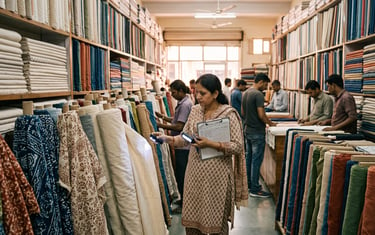
In the UK, France, or the United States, a hand-block-printed cotton fabric or a natural-dyed handloom weave is a specialty commission that takes weeks to arrange and costs accordingly. In Jaipur and the surrounding Rajasthan textile ecosystem, these fabrics are produced continuously as a normal part of the regional textile industry. They're not exotic — they're the product of craft clusters that have operated without interruption for generations. For international brands whose market positioning relies on material distinctiveness, this is genuinely valuable.
The Organic Cotton Supply Chain
India produces approximately 51% of the world's certified organic cotton, primarily from Gujarat, Maharashtra, and Rajasthan. For brands sourcing GOTS-certified organic cotton, India doesn't just offer competitive pricing — it offers a domestic supply chain that gives your manufacturer genuine access to certified materials without the import complexity that organic cotton sourcing involves in other manufacturing countries.
Price Points for Quality That Aren't Available in Europe
A 140 GSM organic cotton voile that retails for £8–£12 per metre in UK fabric retailers can be sourced in Jaipur for £0.90–£1.80 per metre in production quantities. A handloom linen that would cost £15–£22 per metre in European specialty fabric markets is available at £2.50–£4.50. These aren't comparable materials — the Indian versions often have better tactile qualities because they come from active craft production rather than mechanised equivalents.
51%
World's organic cotton produced in India
£0.90
Min. per metre for quality cotton voile (production qty)
300+
Distinct fabric types available in Jaipur markets
3–5 days
Swatch delivery to UK / EU / Australia (courier)
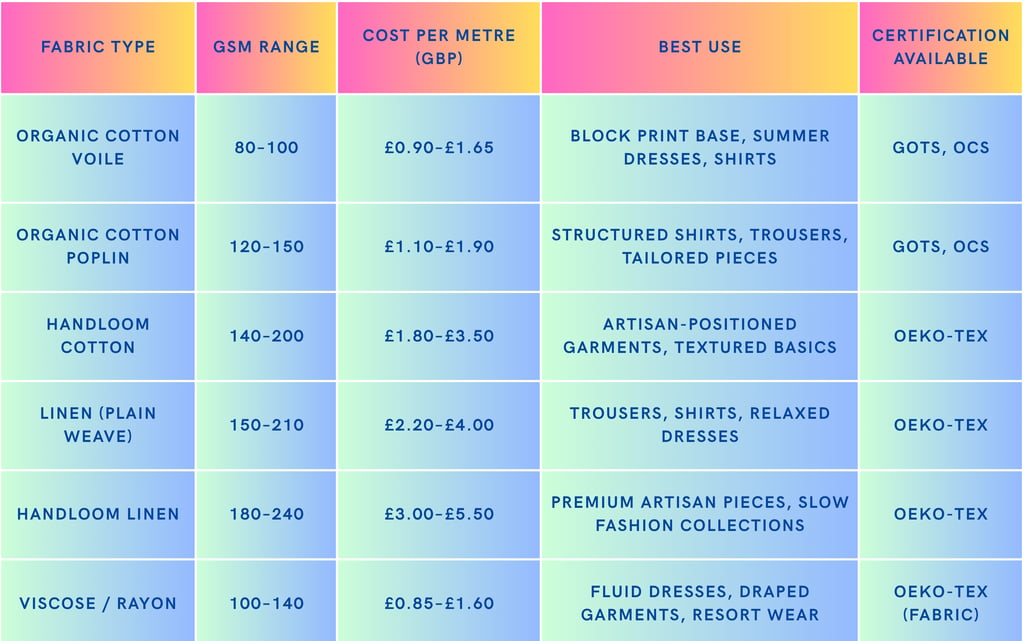
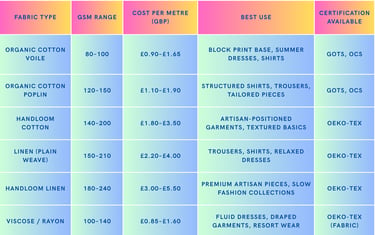
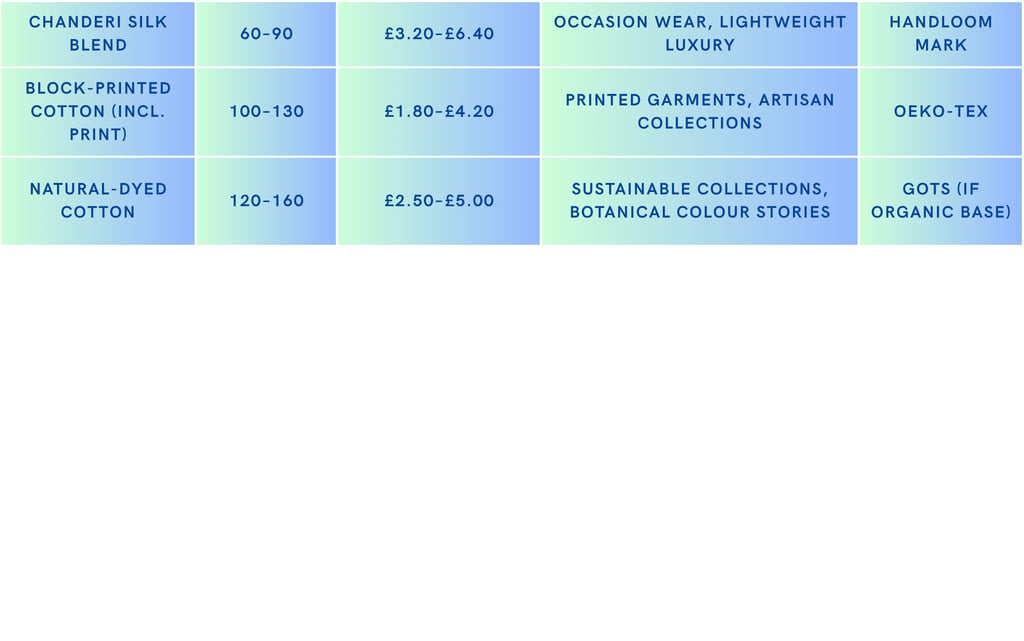
All prices are indicative for production quantities (typically 50–200 metres minimum from suppliers). Below the production minimum, expect to pay 20–40% more per metre from wholesale market traders.
How Your Manufacturer Sources Fabric: What Actually Happens
1) You specify — they search
You provide fabric specification: type, composition, weight (GSM), weave, finish, and colour direction. Your manufacturer searches their established supplier network for options matching your spec. This typically takes 2–5 days. Professional manufacturers work with known, vetted fabric suppliers — not random market traders — which matters for consistency across reorders.
2) Swatches come to you
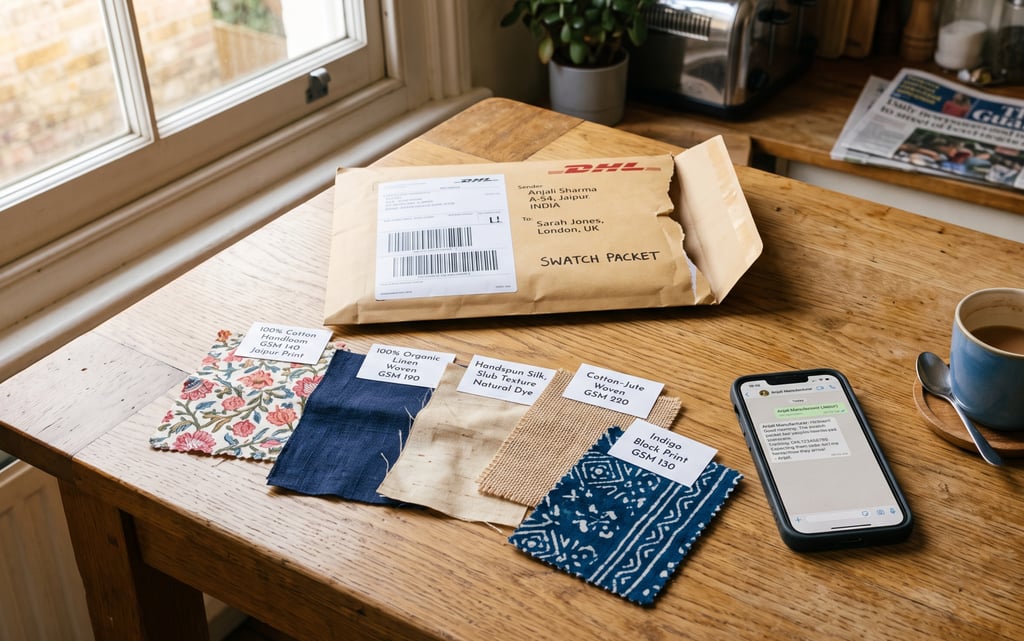
The manufacturer sends 3–5 physical swatches to your address — in the UK, USA, Canada, Australia, New Zealand, or Europe — by courier. This typically costs £12–£25 in shipping and takes 3–6 days. These are actual fabric samples from the production source, not stock images. You evaluate hand-feel, weight, weave quality, and colour against your direction.
3) You approve — they order
Once you select your preferred fabric and confirm colour direction, the manufacturer orders the required fabric quantity (usually your production amount plus a 10–15% overage for cutting waste). Fabric lead time from order to receipt at the manufacturer's facility: 3–10 days for stocked fabrics; 2–4 weeks for specially woven or dyed materials.
4) Fabric quality check
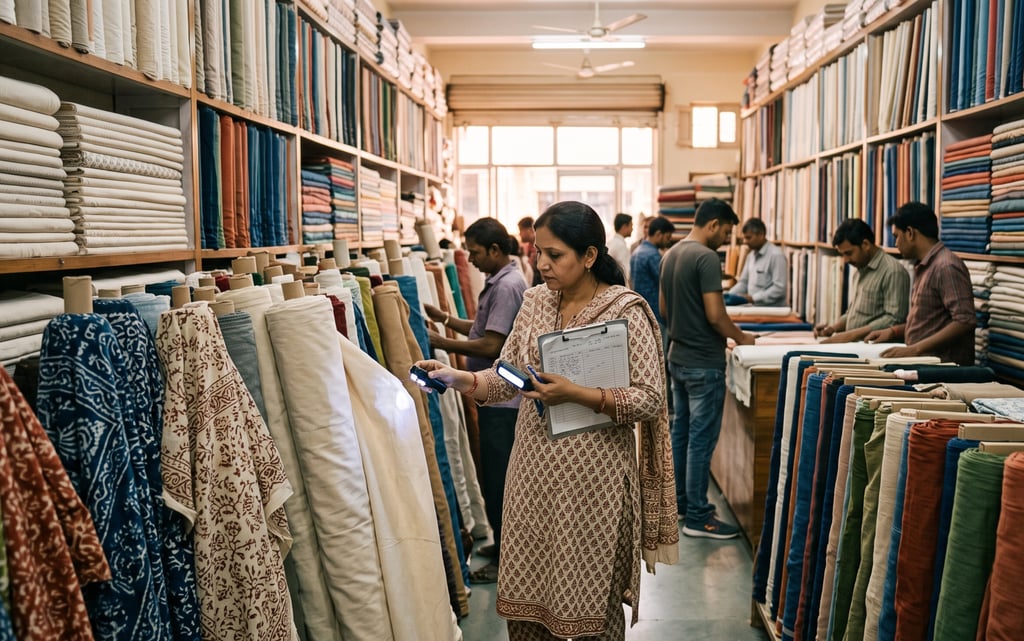
A professional manufacturer performs an incoming quality check on the fabric: weight per square metre is measured, shrinkage is tested by washing a sample, colour fastness is tested, and weave defects are counted across the roll. This step is standard practice for serious manufacturers. If you're not asked about your quality tolerance at this stage, ask why.
5) Compliance documentation
For EU and UK buyers, request OEKO-TEX Standard 100 test reports or GOTS certification documentation at this stage. REACH compliance documentation should be provided for all fabrics sold into the EU market. A manufacturer who knows their export markets provides this without being asked. One who doesn't know why you need it is telling you something important about their export experience.
Requesting Fabric Swatches: Exactly What to Specify
Vague fabric requests produce unsuitable swatch selections. Here is the exact specification format that produces useful results:
Fabric Request Example (what to send your manufacturer):
"We need cotton voile, 100% cotton, approximately 90–100 GSM, plain weave (not dobby), unwashed finish, in a natural undyed ivory. Ideally GOTS certified or OEKO-TEX Standard 100 certified. Please send 3–4 swatch options by DHL to [your address]. We'll approve and pay for courier. Quantity needed for bulk: 120 metres (60-piece production run of a midi dress using approximately 2 metres per unit)."
That single paragraph contains: fibre content, GSM range, weave structure, finish, colour direction, certification requirement, delivery method, and quantity. Your manufacturer can act on it immediately without further clarification.
What to Check When Fabric Swatches Arrive
✓Does the weight feel right for the garment you're making? A 90 GSM voile will be near-transparent; a 130 GSM poplin will have structure. Hold each swatch up to light to check transparency.
✓Does the colour match your direction in both natural and artificial light? Fabric colours read differently under different lighting conditions — check both before approving.
✓Does the weave have a consistent structure, or are there visible irregularities? For handloom fabrics, slight variation is a feature. For standard woven fabrics, it's a quality concern.
✓Wet a small piece of each swatch and dry it. Does the colour bleed? Does it shrink dramatically? Knowing this before bulk production prevents unpleasant surprises after washing the finished garments.
✓Rub the fabric against a similar piece. Does the surface pill immediately? Pilling resistance matters for garments that will be washed repeatedly.
⚠Never approve fabric based on digital photos alone. The tactile qualities of fabric — weight, drape, hand-feel — cannot be assessed from an image. If a manufacturer suggests skipping physical swatch approval, that's a procedural shortcut that will cost you.
We Source Fabric and Send Swatches to Your Door
Tell us your fabric direction — type, weight, colour, certification preference, and quantity. We'll identify 3–5 options from our supplier network and send physical swatches to your address in the UK, USA, Canada, Australia, New Zealand, or Europe. Most swatch packages arrive within 4–6 days of dispatch. Your approval triggers fabric procurement and production scheduling.
Once your fabric is approved, the next stage is pre-production sampling. Read our complete guide to garment sampling in India to understand exactly what happens between fabric approval and your first production run.
Contact
Reach out for custom orders or questions
call | Whatsapp | email
ashanariindia@gmail.com
Nitin +91-9351612343
Deepti +91-9549123654
Address:
Ashanari Pvt. Ltd.
A-68, Vidhyut Nagar, Ajmer Road, Jaipur,
Rajasthan, India -302021
© 2018. All rights reserved by Ashanari Pvt. Ltd
info@ashanari.com