

How to Choose a Custom Garment Manufacturer | 2025 Guide
How to choose a custom garment manufacturer that actually delivers. A practical decision guide for brand founders in the UK, USA, Canada, Australia and Europe.
GETTING STARTED
Ashanari
7/17/20265 min read


How to Choose a Custom Garment Manufacturer: A Practical Decision Guide for UK, US, Canadian and Australian Brands
The manufacturers who cause problems are rarely the ones who look obviously bad. They usually look fine — a decent website, polite emails, a reasonable price, photos of a tidy-looking workshop. The problems emerge later: a sample that doesn't match your brief, a delivery that arrives three weeks late, a bulk order where 15% of the units have quality issues the manufacturer disputes responsibility for.
Choosing well requires a framework that goes beyond gut feel and email impressions. This guide gives you one.
Direct Answer — "How do I choose the right custom garment manufacturer?"
Choose a custom garment manufacturer based on five factors: whether they genuinely manufacture in-house (not just broker orders), their track record with brands from your market, the quality of their pre-production sample process, how clearly they communicate before you've paid them anything, and whether their minimum order quantity matches your realistic production volume. Price should be the last comparison point, not the first.
The Five Criteria That Actually Separate Good Manufacturers from Unreliable Ones
1. They Manufacture In-House — Not Through Agents
The single most important question you can ask a prospective manufacturer is: "Do you cut, sew, and finish in your own facility?" A surprising number of companies who present themselves as manufacturers are, in practice, trading agents who place your order with a factory they have no direct control over. This adds cost, removes quality oversight, and creates communication delays at every stage.
How to verify: ask for a video walkthrough of their production floor. Request photos of your specific fabric being cut during production. Ask whether they can introduce you to the production manager who will be responsible for your order. Genuine manufacturers answer all three without hesitation. Agents deflect or deliver generic responses.
2. They Have Direct Experience Shipping to Your Market
A manufacturer who has shipped hundreds of orders to the UK understands the documentation requirements, the customs process, and what can go wrong. They know to include a certificate of origin for GSP duty claims. They know what UK import duty rates apply to your specific garment category. They know how to label for UK compliance. The same applies to US, Canadian, Australian, New Zealand and European markets — each has distinct requirements.
Ask directly: "What percentage of your current clients are based in [your country]? Can you name two brands from my market I could speak to?" A manufacturer with genuine export experience answers both questions specifically. One without it gives you vague reassurances.
3. Their Sample Process Is Systematic, Not Ad Hoc
The pre-production sample is where the quality of a manufacturer's process reveals itself. What you want to see:
A clear sample timeline they commit to before you pay
A structured feedback process — they send you a measurement checklist alongside the sample, not just the garment
A defined revision policy — how many rounds are included, what additional rounds cost, what constitutes a fault versus a design change
Sample cost that credits to your first bulk order (standard practice for professional manufacturers)
A manufacturer who treats sampling as an administrative inconvenience to get through before production starts will transfer that attitude to every aspect of your working relationship.
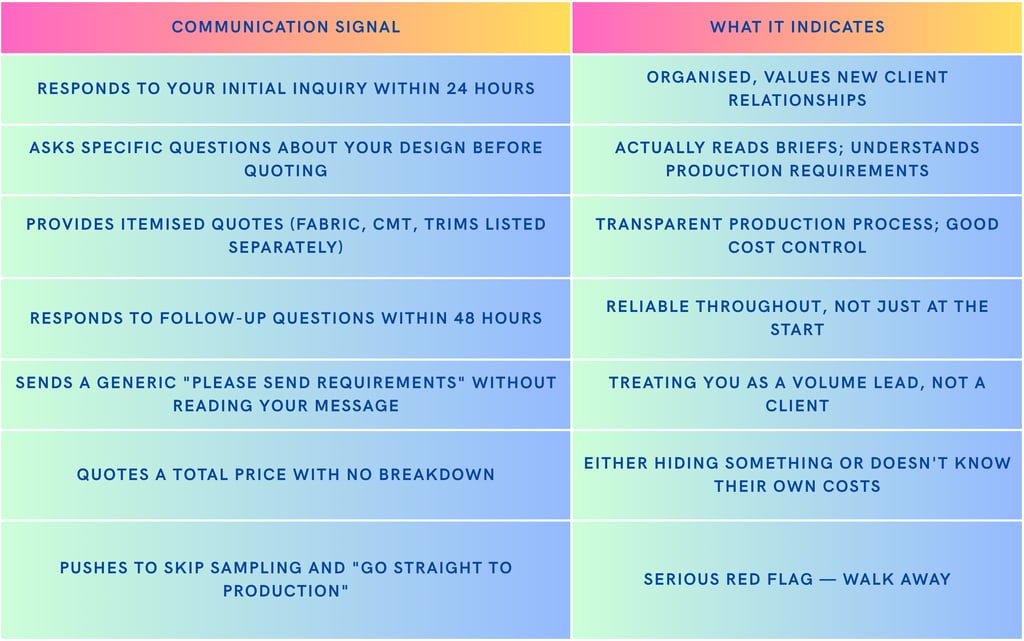
4. Their Communication Is Clear Before You've Paid Them
How a manufacturer communicates during the inquiry stage is a near-perfect preview of how they'll communicate during production. Measure:
5. Their MOQ Matches Your Business Reality
A manufacturer who normally produces 500-unit runs and reluctantly accommodates your 80-unit request is not the right partner for your current stage. Their pricing will reflect the inconvenience, their production scheduling will reflect it, and you'll never be a priority client. Find a manufacturer whose natural operating range includes your realistic order size.
At Ashanari, our minimum is 50 units per style. That's not a concession we make for difficult clients — it's the order size our production model is designed around. When you place a 60-unit order with us, you're a standard client, not an exception we're tolerating.
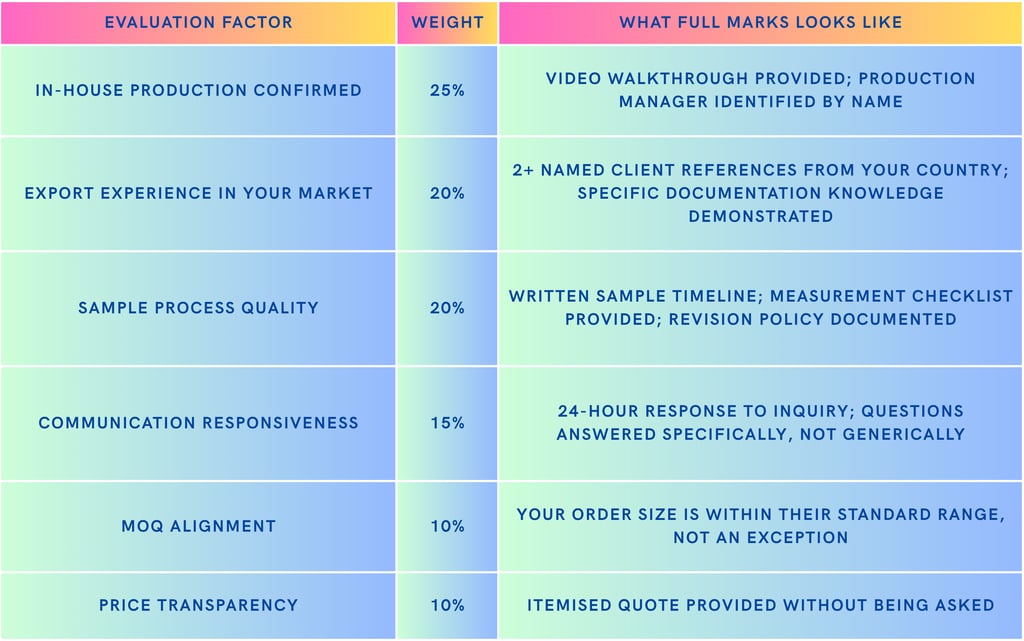
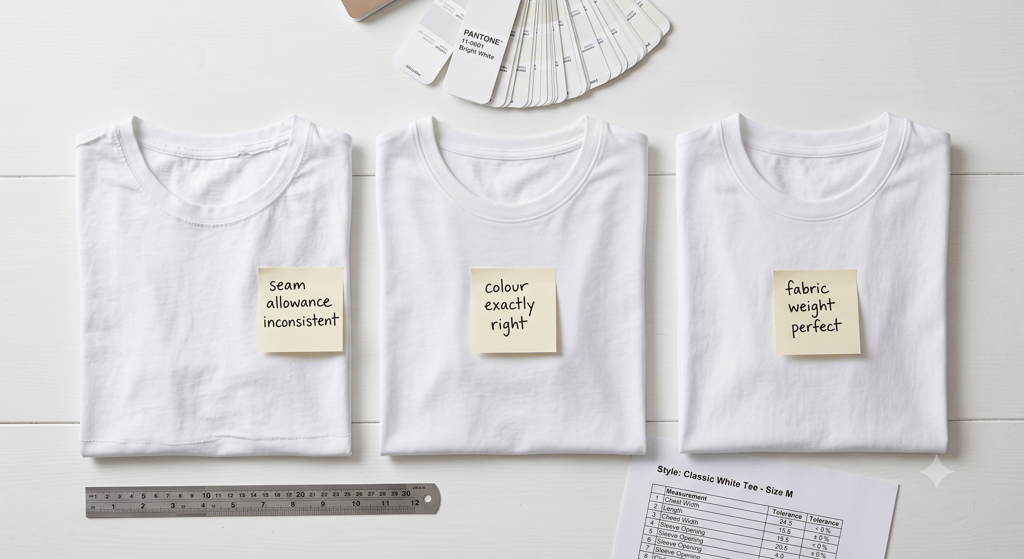
A Practical Evaluation Framework: How to Compare Three Manufacturers Side by Side
Once you have three shortlisted candidates, score them across these dimensions:
Country-Specific Considerations When Choosing an Indian Manufacturer
🇬🇧
United Kingdom
Confirm your manufacturer understands UK import documentation — particularly certificate of origin for UK GSP claims. Under the UK's developing trade relationship with India, buyers should verify current duty rates for their specific HS code with a UK customs broker before placing large orders. DDP shipping to UK addresses is available from professional exporters.
🇺🇸
United States
Your manufacturer must understand US HTS codes and Customs and Border Protection documentation. For children's clothing, CPSC compliance and California Prop 65 requirements apply. Confirm your manufacturer has experience with US import documentation specifically — not just "international shipping." Section 301 tariffs do not apply to Indian goods, which is a material cost advantage over Chinese sourcing.
🇨🇦
Canada
Under Canada's General Preferential Tariff (GPT), Indian clothing typically attracts 0–18% duty depending on the tariff item. Confirm your manufacturer understands CBSA documentation requirements. Canada Border Services Agency may require Form B3 (Customs Coding Form) for commercial imports. Your freight forwarder handles this, but your manufacturer should be familiar with the paperwork.
🇦🇺
Australia
Australia applies 0% import duty to most clothing from India — one of the most favourable import environments for Indian textile buyers globally. Confirm your manufacturer understands Australian Border Force documentation. The GATT standard CN22/CN23 customs declarations apply to smaller shipments. GST (10%) applies on import but is reclaimable for GST-registered businesses.
🇳🇿
New Zealand
New Zealand applies 0% or very low duty rates on most clothing imports under its tariff schedule. GST (15%) applies on the customs value of imported goods. Confirm air freight routing — most Jaipur-to-NZ shipments route through either Singapore (SIN) or Melbourne (MEL). Transit time: 7–10 days by air. Freight costs are higher per kg than to Australia — factor this into your cost model.
🇪🇺
European Union
EU GSP rates for Indian clothing run 9–12%. REACH compliance documentation is mandatory for EU market sales — request AZO dye test reports and OEKO-TEX certification from your manufacturer. EUR-denominated invoicing simplifies EU customs valuation and VAT reclaim. DDP shipping to Rotterdam, Hamburg, or Antwerp available from established Indian exporters.
The One Thing That Matters More Than Everything Else
After a manufacturer passes the five criteria above, order a sample before you commit to anything significant. Not because you don't trust them — because trust is earned through evidence, not through a good email thread. A sample order of £100–£250 across one or two styles will tell you more about a manufacturer's actual capability than any amount of research, reference checking, or video calls.
The manufacturers who push back on sample orders, or who make sampling feel like an obstacle rather than standard practice, are telling you something important about how they operate.
See How Ashanari Handles the First Enquiry
We respond to every genuine inquiry within 24 hours with specific answers — not a generic "please send your requirements." We provide itemised quotes, explain our sample process upfront, and offer references from clients in your market. If you want to see what transparent manufacturer communication looks like before you commit to anything, send us your brief.
Once you've chosen a manufacturer, the next step is understanding the pre-production process. Read our complete guide to tech packs, sampling, and fabric sourcing for the full picture of what happens after you make your choice.
Contact
Reach out for custom orders or questions
call | Whatsapp | email
ashanariindia@gmail.com
Nitin +91-9351612343
Deepti +91-9549123654
Address:
Ashanari Pvt. Ltd.
A-68, Vidhyut Nagar, Ajmer Road, Jaipur,
Rajasthan, India -302021
© 2018. All rights reserved by Ashanari Pvt. Ltd
info@ashanari.com