
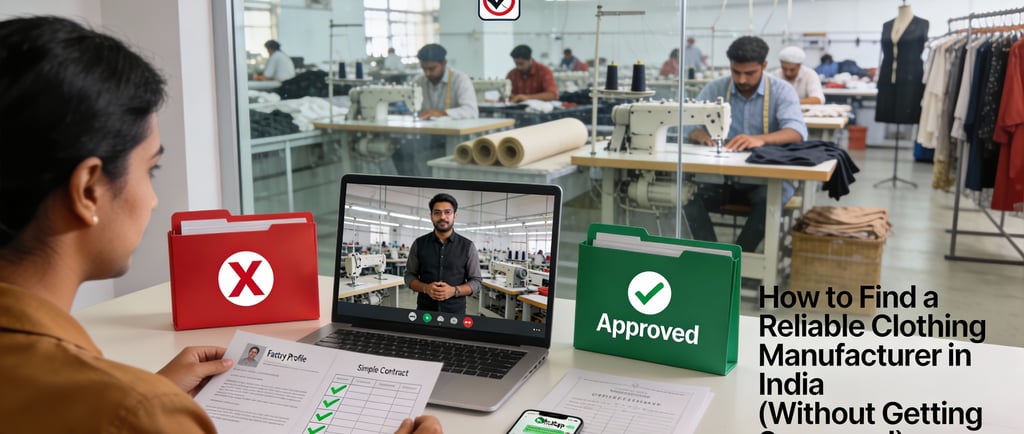
How to Find a Reliable Clothing Manufacturer in India (Without Getting Scammed) post
How to Find a Reliable Clothing Manufacturer in India
Ashanari
12/16/202511 min read
Three months ago, Olivia from Manchester wired £8,000 to a clothing manufacturer she found on Instagram. The factory looked legitimate—professional photos, glowing reviews, even video tours. She paid 50% upfront for 300 custom dresses. The manufacturer went silent after receiving payment.
No products. No refunds. No responses.
Olivia isn't alone. Every month, dozens of new clothing brands—from Mumbai to Melbourne—lose thousands to fraudulent manufacturers. According to a 2024 report by the Federation of Indian Export Organizations, clothing-related fraud costs international buyers over $120 million annually in India alone.
But here's the reality: India is home to some of the world's most skilled, reliable, and ethical clothing manufacturers. Cities like Jaipur, Tirupur, and Delhi produce millions of high-quality garments for global brands every year. The craft heritage, competitive pricing, and manufacturing expertise are real.
The problem isn't India. The problem is knowing how to separate legitimate manufacturers from sophisticated scammers.
After 15 years running Ashanari in Jaipur and working with over 300 international brands, I've seen every scam, every red flag, and every warning sign. I've also helped brands recover from bad experiences and find trustworthy partners.
This isn't another generic "how to find a manufacturer" guide. This is the hard-earned, sometimes painful knowledge of what actually works—and what will cost you everything.
Why Clothing Manufacturing Scams Are So Common (And Sophisticated)
Let's address the uncomfortable truth: the clothing manufacturing industry has a trust problem.
The Perfect Storm:
1. High Upfront Costs: Unlike dropshipping or print-on-demand, custom manufacturing requires significant deposits—typically 30-50% upfront. That's £5,000-15,000 ($6,000-18,000) or ₹5-12 lakhs before you see a single sample.
2. Geographic Distance: Most Western brands manufacture in Asia. You can't just "pop by" to check on production. This distance creates opportunity for deception.
3. Legitimate-Looking Fronts: Modern scammers don't work from sketchy websites anymore. They have professional Instagram accounts, WhatsApp Business profiles, verified Google Business listings, and fake client testimonials.
4. Language Barriers: Miscommunication isn't just about language—it's about business culture, expectations, and terminology. Scammers exploit this.
5. Desperation: New brands are often in a hurry to launch. Scammers recognize urgency and use it against you.
The Most Common Clothing Manufacturing Scams in India
Scam #1: The Ghost Factory
How it works: A "manufacturer" has a beautiful website, social media presence, and responds quickly to inquiries. They send professional quotes, have video calls with you, and seem perfect. You pay the deposit. They ghost you.
Real Example: A Sydney-based designer, Marcus, found a manufacturer through a Facebook ad. Professional website, certificate logos (ISO, GOTS), client list including recognizable brands. He video-called them—they showed him a factory floor. He sent $12,000 AUD. Two weeks later, all contact stopped. The website went offline. The phone numbers disconnected.
The Reality: The "factory" was a rented space for the day. The certificates were Photoshopped. The client list was stolen from real manufacturers.
Warning Signs:
Recently created social media accounts (less than 1 year)
Stock photos instead of actual production photos
Won't provide verifiable references
Pressure to pay quickly ("limited slots available")
Payment only through personal accounts, not business accounts
No physical address or vague location
Scam #2: The Bait-and-Switch Quality
How it works: You receive beautiful samples. You approve and pay for bulk production. The delivered products are completely different quality—cheaper fabric, poor stitching, wrong measurements.
Real Example: Priya from Delhi ordered 200 linen dresses. Samples were perfect—soft linen, clean stitching, accurate measurements. Bulk order arrived: rough polyester blend, uneven hems, sizes off by 2 inches. The manufacturer said "you approved the sample, no refunds."
The Reality: Samples were made in a small quality unit. Bulk production was outsourced to the cheapest factory available, often without your knowledge.
Warning Signs:
Unwilling to provide pre-production samples from bulk fabric
No mid-production quality checks offered
Vague answers about their production facility
Prices significantly below market rates
Rush to move from sample to bulk production
Scam #3: The Hidden Costs Trap
How it works: Initial quote looks amazing. You proceed. Then come the extras: "Quality control fee," "expedited handling," "special packaging charge," "fabric shortage surcharge," "festival season bonus." Your ₹5 lakh order becomes ₹8.5 lakhs.
Real Example: A London brand ordered kurtas quoted at £15 per piece. Final bill included: fabric shortage fee (15%), GST (18% not mentioned initially), quality inspection charge (₹15,000), special embroidery setup (₹25,000), packaging upgrade (₹40,000). Cost per piece went from £15 to £23.
The Reality: The initial quote was intentionally incomplete to get you committed. Once you've invested time and samples, they add mandatory "extras."
Warning Signs:
Quote doesn't itemize costs
No mention of GST, taxes, or additional fees
"All-inclusive" pricing that's suspiciously low
Costs keep appearing throughout production
Verbal quotes that don't match written agreements
Scam #4: The Fake Certifications
How it works: Manufacturer displays ISO 9001, GOTS, WRAP, OEKO-TEX, and other certifications on their website. You believe you're working with a certified, ethical factory. The certificates are fake.
Real Example: A sustainable brand from Australia specifically sought GOTS-certified manufacturers. Found one in Bangalore with GOTS and Fair Trade logos on their website. Paid €20,000 for organic cotton production. When audit was requested, manufacturer admitted certificates were "pending renewal" (i.e., never existed).
The Reality: Certificate logos are easy to copy. Many manufacturers display them for credibility without actual certification.
Warning Signs:
Can't provide certificate numbers
Won't share PDF copies of actual certificates
Certificates aren't from recognized certifying bodies
"In process of certification" for years
Generic certificate images instead of their specific documents
Scam #5: The Middleman Masquerade
How it works: You think you're dealing with a manufacturer. You're actually dealing with a middleman who outsources to unknown factories. Your costs are inflated, quality is uncontrolled, and communication is a nightmare of telephone game.
Real Example: Raj from Pune thought he found a great Jaipur manufacturer for block-print dresses. Turns out, "manufacturer" was a Mumbai-based agent who outsourced to three different Rajasthan factories. Quality varied wildly across orders. Agent charged 40% markup. Communication delays were constant because agent was coordinating multiple parties.
The Reality: Many "manufacturers" on Alibaba, IndiaMART, and Instagram are brokers, not actual factories.
Warning Signs:
Reluctant to share factory location
Can't provide factory tour (even virtual)
"We work with multiple units" (red flag for agents)
Address is residential or office building, not industrial area
Can't show machinery or production floor
Different products have wildly different capabilities
The Foolproof System: How to Vet Indian Manufacturers
Here's the exact process I recommend to every brand that contacts Ashanari, even if they're not working with us:
Step 1: Initial Research (Don't Skip This)
Google Search Test:
Search the company name + "scam" or "fraud" or "complaint"
Search the company name + "review"
Check their website domain age (use who.is)—anything under 2 years is caution
Search their email address and phone number independently
Social Media Audit:
Check account creation date
Are photos original or stock images? (Use Google reverse image search)
Do they have real engagement or just likes? (Check comments for authenticity)
Do posts show actual production or just product photos?
Business Verification:
In India, ask for GST number (GSTIN)—verify it on the government GST portal (gst.gov.in)
Ask for Import-Export Code (IEC) if they claim to export
Request company incorporation documents (Certificate of Incorporation)
Example Script: "Hi, I'm interested in manufacturing with you. Before we proceed, could you please share your GSTIN, IEC code, and company incorporation certificate? I need these for my records. Thank you!"
Legitimate manufacturers will provide these immediately. Scammers will make excuses or ghost you.
Step 2: Communication Assessment (First 72 Hours)
How a manufacturer communicates in the first 72 hours tells you everything.
Green Flags:
Responds within 24 hours
Asks detailed questions about your project
Provides itemized quotes
Mentions their production capabilities AND limitations
Offers to schedule a proper video call
Shares their process timeline honestly
Provides references or portfolio without you asking
Red Flags:
Takes days to respond, then suddenly urgent when you're ready to pay
Agrees to everything without questions
Quote comes in minutes (real quotes take time)
Pushes for immediate payment
Communication only through personal WhatsApp, never email
Grammar/professionalism varies wildly (sign of multiple people managing account)
Step 3: The Video Call Test (Non-Negotiable)
Never work with a manufacturer you haven't video-called.
Schedule a video call and request a live factory tour. Here's what to watch for:
During the Call:
✅ Ask them to show you:
Production floor in real-time (not a pre-recorded video)
Actual machines in operation
Fabric storage area
Quality control section
Their sampling department
Workers at stations (if appropriate timing)
✅ Ask these questions:
"How many people work here?"
"What brands do you currently manufacture for?" (They should be comfortable naming at least 2-3)
"Can you show me samples of similar work you've done?"
"What's your typical production capacity per month?"
"What are your busiest months?" (Should match industry norms—March-May, Aug-Oct in India)
❌ Red Flags During Call:
Can't or won't show factory floor
Shows only office/meeting room
Background looks residential
Can't show machinery or samples
Other "factories" visible in background (middleman)
Promises everything instantly without consulting team
Step 4: Sample Verification (The Truth Revealer)
Never skip sampling. Never. And don't accept just one sample round.
The Right Sample Process:
Request a sample in your fabric/design
Don't accept "similar" work from past clients
Pay for the sample (free samples often mean they don't value the work)
Request a second sample with specific changes
This tests their attention to detail and quality consistency
If they can't execute your requested changes, they can't handle bulk
Request a pre-production sample from bulk fabric
This must be made from the actual fabric batch for your order
This is your last chance to catch quality switching
Sample Red Flags:
Won't send samples (huge red flag)
Sample quality degrades from round 1 to round 2
Can't replicate the same quality across multiple samples
Different samples look like they came from different factories (middleman)
Excessive delays in sampling (weeks beyond promised time)
Step 5: Reference Verification (Do It Right)
Don't just ask for references—verify them properly.
What to Request: "Could you share contact information for 2-3 brands you've worked with in the past year? I'd like to hear about their experience."
When You Contact References:
Ask:
How long have you worked with this manufacturer?
Were they honest about timelines and costs?
Any surprise charges or issues?
How do they handle mistakes or quality issues?
Would you order from them again?
On a scale of 1-10, how would you rate communication?
Reference Red Flags:
Won't provide references
References are all in different countries/unreachable
References give scripted, perfect answers (fake reviews)
Can't verify references actually exist or worked with them
Step 6: Payment Structure Evaluation
How you pay reveals a lot about legitimacy.
Safe Payment Terms:
30-50% advance upon order confirmation
50-70% before shipment
Payment to company business account, not personal account
Detailed invoice with GST, itemized costs
Payment agreement in writing
Dangerous Payment Demands:
100% upfront payment required
Payment to personal account or individual
Payment through cryptocurrency or untraceable methods
"Special discount for full payment now"
Pressure to pay immediately or lose slot
Payment through Western Union, MoneyGram, or similar
Safe Payment Methods:
Bank wire transfer to business account
PayPal Business (has some buyer protection)
Escrow services for first order
Letter of Credit (for large orders—₹25+ lakhs/$30,000+)
Never use:
Personal money transfer apps
Cash in person (unless you're at the factory)
Cryptocurrency
Gift cards (obvious scam)
Step 7: Contract and Documentation
Everything in writing. Everything.
Minimum Contract Requirements:
Detailed Specifications
Exact product descriptions
Fabric type, weight, composition
Measurements (size chart)
Color codes (Pantone/RGB)
Stitching requirements
Label and packaging specifications
Pricing Breakdown
Per-piece cost
Minimum order quantity
Sample costs and when/if credited
Shipping costs or FOB price
Payment schedule
GST and taxes (who pays what)
Timeline
Sampling timeline
Bulk production start date
Estimated completion date
Shipping date
What happens if delays occur
Quality Standards
Inspection process
Acceptance criteria
What happens if quality is substandard
Return/refund policy
Legal Terms
Jurisdiction (which country's laws apply)
Dispute resolution process
Intellectual property protection
Confidentiality agreements
If a manufacturer refuses to sign a contract, walk away immediately.
Real Success Story: How Sophie Did It Right
Sophie from London wanted to manufacture hand-block printed dresses in India. She'd heard horror stories but also knew India was the right place for authentic craft.
Here's what she did right:
Month 1: Research
Spent 3 weeks researching Jaipur manufacturers
Googled every company, checked GST numbers
Joined Facebook groups for fashion entrepreneurs
Asked for recommendations in entrepreneur forums
Month 2: Vetting
Contacted 12 manufacturers
Had video calls with 6
Eliminated 4 based on communication and facility tours
Requested samples from 2 finalists
Month 3: Sampling
Ordered samples from both (paid £150 each)
Requested revisions from both
One delivered revised sample in 8 days, other took 21 days
Quality and communication made decision clear
Month 4: Small Test Order
Ordered only 50 pieces (not 500)
Signed detailed contract
Paid 30% advance to business account
Requested mid-production photos (manufacturer provided willingly)
Month 5: Delivery
Products arrived as expected
Quality matched samples
Sizes accurate
Only issue: 3 pieces had minor stitching flaws (2% defect rate—acceptable)
Result: Sophie has now placed 8 orders over 18 months. Her brand generates £180,000 annually. She plans to visit the Jaipur facility in person next quarter.
Her advice: "The right manufacturer won't rush you. They'll ask questions, point out potential issues, and be honest about timelines. If it feels too easy or too perfect, it probably is."
The India Advantage: Why It's Worth Getting Right
Despite the risks, India remains one of the world's best clothing manufacturing destinations. Here's why:
1. Craft Heritage
Hand block printing (Jaipur, Bagru)
Hand embroidery (Lucknow chikankari, Kashmiri embroidery)
Handloom textiles (Chanderi, Banaras silk, khadi)
Traditional techniques that command premium pricing globally
2. Fabric Diversity
Cotton capital (Gujarat, Maharashtra)
Silk hub (Bangalore, Banaras)
Synthetic center (Surat)
Sustainable options (organic cotton, bamboo, hemp)
3. Skilled Labor
Generations of textile expertise
Artisans trained in traditional crafts
Understanding of both Eastern and Western aesthetics
4. Cost Efficiency
40-60% lower costs than US/UK manufacturing
Competitive even compared to China for customization
Small batch feasibility (30-50 piece MOQ possible)
5. Scalability
Can grow from 50 pieces to 5,000 pieces with same partner
Infrastructure for both small batch and mass production
6. Flexibility
Willing to work on custom designs
Adaptable to international sizing standards
Open to small modifications and iterations
The key is finding the 5% of manufacturers who are professional, ethical, and reliable. This guide helps you do exactly that.
What We Do at Ashanari (And Why Transparency Matters)
At Ashanari, we've built our entire business on the trust deficit in this industry.
Here's our approach:
✅ Verified Credentials:
GST number: [XXXXX] (verify at gst.gov.in)
IEC Code: [XXXXX]
Company registration: 15 years
Physical address: Jaipur, Rajasthan (visitors welcome by appointment)
✅ Transparent Process:
Detailed written quotes within 24 hours
Itemized pricing (no hidden costs)
Sample costs credited to bulk orders
Video factory tours before you commit
✅ Fair Payment Terms:
30% advance, 70% before shipping
Business account payments only
GST invoices for all transactions
Written contracts for every order
✅ Quality Commitment:
Multi-point quality inspection
Mid-production photo updates
Pre-shipment inspection reports
Less than 2% defect rate maintained
✅ Realistic Timelines:
Sampling: 5-10 days
Bulk production: 25-35 days
We under-promise and over-deliver
We're not the cheapest. We're probably not the fastest.
But we're here in 5 years when you need your 50th order, not just your first.
Your Action Plan: Next Steps
If you're ready to find a reliable manufacturer:
Week 1:
Create a list of 10-15 potential manufacturers
Verify GST numbers and business credentials
Check reviews and online presence
Google search company name + "scam"/"review"
Week 2:
Email inquiry to top 8 manufacturers
Assess response time and communication quality
Request detailed quotes
Eliminate based on red flags
Week 3:
Schedule video calls with top 4
Request live factory tours
Ask all verification questions
Check references
Week 4:
Order samples from top 2 finalists
Compare quality, timeline, communication
Request sample revisions to test responsiveness
Make final decision
Month 2:
Negotiate contract terms
Get everything in writing
Start with small test order (50-100 pieces)
Build relationship before scaling
Final Thoughts: Trust, But Verify
The Indian clothing manufacturing industry has incredible potential. The artisans are skilled. The costs are competitive. The quality can be world-class.
But the trust deficit is real.
Your job isn't to avoid Indian manufacturers—it's to find the right one.
Use this guide. Follow the steps. Ask the hard questions. Verify everything.
The right manufacturer won't be offended by your diligence. They'll appreciate it. They'll work with clients who do their homework because those relationships last.
I've seen hundreds of brands thrive with Indian manufacturing. I've also seen brands lose everything. The difference wasn't luck—it was preparation.
Do the work upfront. Protect yourself. Then build something beautiful.
Ready to Start Your Manufacturing Journey?
Work with a transparent, verified manufacturer from day one.
Ashanari | Custom Clothing Manufacturing in Jaipur
✅ 15+ years in business ✅ Verified GST and IEC credentials ✅ 300+ brands served (India, USA, UK, EU, Australia) ✅ MOQ: 30-50 pieces ✅ Specialty: Ethnic wear, dresses, formal wear, hand block printing ✅ Transparent pricing, fair contracts, quality guaranteed
Contact Us: 📧 Email: Ashanariindia@gmail.com 🌐 Website: www.ashanari.com 📱 WhatsApp/Call: +91-9549123654
We offer:
Free consultation call (30 minutes)
Detailed quote within 24 hours
Sample costs credited to bulk orders
Factory video tour before you commit
Don't become another horror story. Start with someone you can trust.
[Schedule Free Consultation] [Request Quote] [View Our Portfolio]
Have questions about finding manufacturers? Drop a comment below or email us directly.
Related Articles:
"The Complete Checklist: 47 Questions to Ask Any Clothing Manufacturer"
"Western Sizing vs Indian Sizing: The £15,000 Mistake"
"Hand Block Printing: Why Jaipur is the Global Capital"
About the Author: This article is based on 15 years of experience at Ashanari, a Jaipur-based B2B clothing manufacturer specializing in ethnic wear, dresses, and custom garment production for international brands. We've helped over 300 brands navigate Indian manufacturing—from first sample to scaling to thousands of pieces.
Share this article with someone starting a clothing brand | Bookmark for your manufacturing research
Contact
Reach out for custom orders or questions
call | Whatsapp | email
ashanariindia@gmail.com
Nitin +91-9351612343
Deepti +91-9549123654
Address:
Ashanari Pvt. Ltd.
A-68, Vidhyut Nagar, Ajmer Road, Jaipur,
Rajasthan, India -302021
© 2025. All rights reserved with ashanari pvt ltd
info@ashanari.com