
how to negotiate moq clothing manufacturer | 2025 Guide
how to negotiate moq clothing manufacturer? MOQ too high? Learn how to negotiate minimum order quantity with clothing manufacturers — what works, what doesn't, and when to walk away entirely.
BRAND BUILDING GUIDES
Ashanari Manufacturing Team
4/30/20264 min read


How to Negotiate MOQ With a Clothing Manufacturer (Without Burning the Relationship)
You've found what looks like the perfect manufacturer. The samples are excellent. The communication is solid. The pricing fits your margin. And then they tell you the MOQ is 300 units per style, and your entire launch budget suddenly doesn't add up.
MOQ negotiation is one of the most commonly discussed topics in fashion founder communities — and one of the most misunderstood. This guide gives you the honest view: what works, what doesn't, when negotiation is worth attempting, and when the manufacturer's MOQ is a signal to look elsewhere rather than push harder.
First: Understand Why MOQs Exist (This Will Help You Negotiate Them)
A manufacturer sets their MOQ based on their actual costs. Every new style requires: fabric ordering (most fabric mills have their own MOQs, typically 50–200 metres), cutting setup (pattern laying, marker making), machine configuration, thread loading, label and trim sourcing, QC setup, and packing configuration. These setup costs are fixed — they don't change whether you order 50 units or 500. The manufacturer's MOQ is the point at which their fixed setup costs are covered by the order margin.
Understanding this gives you leverage: if you can reduce the manufacturer's setup cost or risk, you can reduce their MOQ requirement.
7 Strategies That Actually Work for MOQ Negotiation
1. Offer a Higher Price Per Unit in Exchange for Lower MOQ
This is the most direct and often most effective approach. If the manufacturer needs a minimum margin per order, you can achieve that at a lower unit count by paying more per unit. A 20–30% per-unit premium in exchange for a 50% reduction in MOQ is frequently acceptable to manufacturers — it maintains their margin while reducing your quantity risk. Run the math: a 30% unit price increase on 50 units versus the original price on 100 units — which is cheaper overall? Often, paying more per unit for fewer units is the better financial outcome for a startup brand.
2. Simplify Your Design to Reduce Production Complexity
Complex garments — multiple fabrics, intricate construction, multi-colour prints — have higher setup costs, which drive higher MOQs. If your design can be simplified without sacrificing its commercial appeal (a single-colour block print rather than four, for example, or a simpler seam construction), the manufacturer's cost base drops and their MOQ requirement often drops with it.
3. Consolidate Styles Across the Same Fabric
Many manufacturers set MOQs per style, but their actual concern is fabric order minimum. If you order two styles in the same fabric, the fabric MOQ is shared between them — effectively halving your per-style minimum. Propose: "I'll order two different silhouettes in the same fabric colourway. Can we work the MOQ across both styles?" Many manufacturers will accept this.
4. Offer a Forward Commitment
Manufacturers value predictability of revenue more than the actual size of any single order. A credible commitment to reorder — "If this first run of 75 units sells within 8 weeks, we'll come back with 300 units within 90 days" — is worth something real to a manufacturer building their production calendar. Put it in writing in your purchase order as an intent clause (not a binding commitment, but a stated intention). Manufacturers who see brands honour their reorder commitments become better partners over time.
5. Propose a Shared MOQ Across Multiple Brands (With Caution)
Some startup brand communities facilitate "group orders" where multiple small brands share a manufacturer's MOQ for the same style. This is viable but requires careful coordination: colour separation, size split agreements, label differentiation, and a clear legal arrangement between participating brands. It works best when brands are genuinely complementary (not competitive) and when all parties have their tech packs and briefs fully prepared before approaching the manufacturer.
⚠️ Important Caveat:
Group orders work with manufacturers who are comfortable managing multiple small accounts simultaneously. Not all manufacturers welcome this arrangement. Confirm before proposing it.
6. Start With a Full-Price Order and Negotiate From Relationship Equity
First-order MOQ negotiation is hard. Third-order MOQ negotiation, after you've been a reliable, communicative, prompt-paying client who delivers clear briefs and gives useful feedback, is much easier. Some of the best sourcing relationships start with accepting a manufacturer's standard MOQ for an initial test run, establishing trust and relationship equity, and then negotiating downward from a position of demonstrated value as a client.
7. Be Honest About Your Stage — and Find a Manufacturer Who Is Built For It
This is the most underrated strategy of all: stop trying to negotiate a 500-unit manufacturer down to 100 units, and find a manufacturer who genuinely operates at 100 units. A manufacturer whose business model is 500+ units will reluctantly tolerate a 100-unit order for you, deprioritise it when their production schedule gets busy, and charge you a premium that doesn't reflect the value they're delivering.
A manufacturer that is built for low MOQ will give your 50-unit order the same care and priority as a 500-unit order — because 50-unit orders are their core business, not a concession they're making for a difficult client.
What Doesn't Work in MOQ Negotiation (And Why)
✗Arguing that your brand will grow quickly: Every brand founder tells manufacturers their brand is going to scale fast. Manufacturers have heard this hundreds of times. Without a track record or confirmed orders, future projections carry no weight in a negotiation.
✗Demanding a lower MOQ without offering anything in return: Negotiation requires a trade. "Please lower your MOQ because it's too high for me" is not a negotiation — it's a request that the manufacturer absorb your business risk.
✗Threatening to go to a competitor: This occasionally works but more often damages the relationship and marks you as a difficult client. If the competitor genuinely has a lower MOQ that works for you, go there — don't use it as a bluff.
✗Trying to negotiate before you have a complete brief: A manufacturer who doesn't know your full specification can't know whether your MOQ request is feasible. Come to any negotiation with your tech pack, fabric spec, and timeline fully prepared.
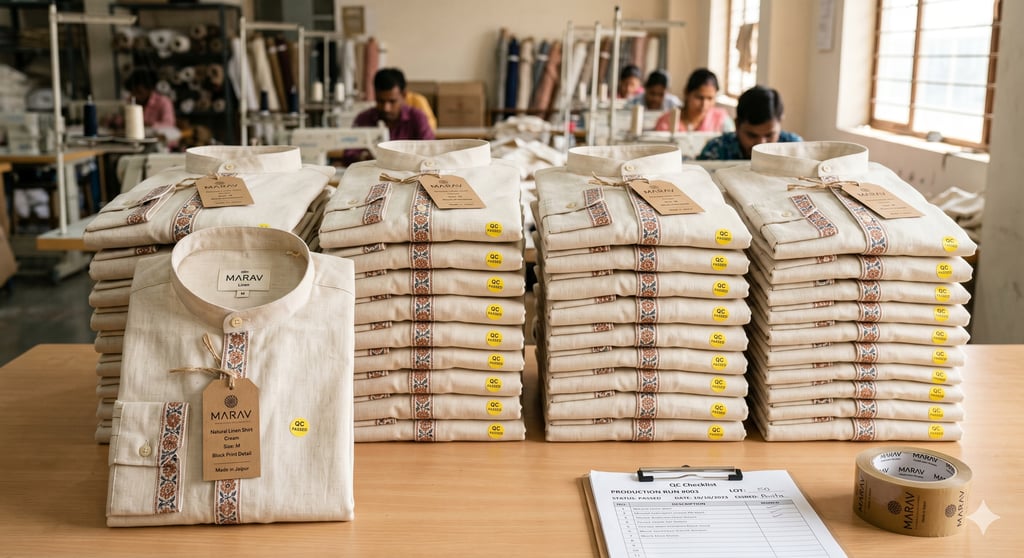
Skip the Negotiation. Start With 50 Units.
Tell us your product concept, quantity, and timeline. We'll confirm the MOQ that works for your order — no negotiation required, no reluctant compromises, no deprioritised production slots. Just a manufacturer who is genuinely built for brands at your stage.
Contact
Reach out for custom orders or questions
call | Whatsapp | email
ashanariindia@gmail.com
Nitin +91-9351612343
Deepti +91-9549123654
Address:
Ashanari Pvt. Ltd.
A-68, Vidhyut Nagar, Ajmer Road, Jaipur,
Rajasthan, India -302021
© 2025. All rights reserved with ashanari pvt ltd
info@ashanari.com