

How to Start a Clothing Brand With No Experience (2025)
Want to start a clothing brand but don't know where to begin? This honest 2025 guide covers every step — from your first idea to your first sale — with real costs and no fluff.
BRAND BUILDING GUIDES
Ashanari Brand Building Guides
7/16/20268 min read
How to Start a Clothing Brand With No Experience in 2025: An Honest, Step-by-Step Guide
Most guides on starting a clothing brand are written by people who've never done it. They list the same ten steps in the same order and leave out the things that actually trip people up — the things that cost real money, the decisions that take real time, and the moments where you find out something about the industry that nobody bothered to tell you upfront.
This is a different kind of guide. It's written by a clothing manufacturer that works with brand founders at every stage of experience — from people who are a week into their idea to founders who are scaling their third season of production. We'll tell you what most guides skip, what things actually cost, and what you genuinely need versus what you only think you need.
Direct Answer — "Can I start a clothing brand with no experience?"
Yes. Most successful independent clothing brand founders started with no fashion industry experience. What they had was a clear sense of who their customer was, a product they understood, and the willingness to learn the production process. Experience helps — but a good manufacturer, a clear brief, and a realistic budget matter more than a fashion degree.
Before You Do Anything: The Questions That Actually Matter First
Most people who want to start a clothing brand start in the wrong place. They worry about logos, website platforms, and Instagram aesthetics before answering the questions that determine whether the business is viable. Do these first:
Who exactly is your customer?
Not "women aged 25–45." That describes approximately 400 million people and tells you nothing useful. The brands that build successfully are the ones who can answer: "My customer is a 32-year-old Berlin woman who shops at sustainable boutiques, follows slow fashion creators on Instagram, spends €300–€600 on a favourite dress, and cares deeply about where her clothing comes from." That's a customer you can design for, market to, and price for.
What problem does your clothing solve — or what story does it tell?
The fashion market is crowded. "Nice clothes" is not a differentiator. What makes your collection different from the thousands of others launching this year? The differentiation doesn't have to be complicated. "Genuinely artisan-made Indian block print, sold at an honest price, with a traceable supply chain" is a differentiation. "Sustainable linen essentials for the European conscious consumer" is a differentiation. "The most flattering linen trouser for women over 40" is a differentiation. Generic is not.
What are you willing to spend — honestly?
A clothing brand can be started for under £3,000 if you make smart decisions. It can also absorb £50,000 and still not be ready to launch if you make poor ones. Understanding your actual budget — not your aspirational budget — shapes every decision that follows.
Step 1: Define Your Product — What You're Actually Making
Your first product range should be ruthlessly focused. Not twenty styles across three categories. Two or three hero garments that embody your brand's core proposition, produced in the minimum quantity you need to validate the market.
Good first product criteria:
Something you understand as a consumer — you know the category, you know what good looks like, you know what your customer wants
A product that can be produced at your budget (see our manufacturing cost guide for real numbers by garment type)
Something with meaningful differentiation — not a white T-shirt, not a generic hoodie, unless you have a very specific story to tell about those items
A product your target customer will actually buy in the quantities you need to make the unit economics work
Step 2: Design Your Collection — You Don't Need to Be a Designer
The most common reason people don't start their clothing brand is "I'm not a designer." This is not actually the barrier it feels like. Here's how brand founders without formal design training create their first collection:
Reference + Direction
Build a precise visual reference library: garments you love, fabrics that excite you, silhouettes that serve your customer, colour palettes that feel right. A well-curated Pinterest board with 40 reference images tells a manufacturer more than a badly executed sketch. Combine this with a written brief that describes the garment in detail and you have enough to start a manufacturer conversation.
Freelance Design Support
Hire a freelance fashion designer or technical designer for the specific work you can't do: turning your references into flat sketches and a tech pack. This costs £150–£400 per style on Upwork and takes 3–7 days. It is far less expensive than the alternatives (design school, permanent hire, or getting the production wrong).
Manufacturer-Supported Development
Work with a manufacturer who offers design development support as part of their pre-production service. Ashanari's team can take your reference images and written brief and develop the technical specifications in-house. This works particularly well for brands whose aesthetic direction is clear but whose technical knowledge is limited. Read more in our guide to working with a clothing manufacturer as a first-time founder.
Step 3: Find Your Manufacturer — The Most Important Decision You'll Make
Your manufacturer is your most important business relationship in the first 3 years of your brand. Choose for fit, not just price.
72%
of failed clothing startups cite manufacturing problems as a primary factor
50
Minimum units per style at Ashanari
£2,900
Realistic minimum first launch investment (2 styles, 50 units each)
65
Average days from first brief to delivery (first order)
For brands building artisan, sustainable, boho, or premium-positioned collections — or for brands that need low MOQ to test their market before scaling — India is where the best manufacturing partners are. Jaipur specifically offers a combination of craft depth, flexible production, and communication quality that no other manufacturing hub matches for small brand founders. Our complete guide to finding a clothing manufacturer covers the full selection process.
Step 4: Sample Before You Spend Anything Significant
The single rule that separates founders who build successful brands from those who don't: always sample before you place a bulk order. A sample order of £100–£300 across two styles will tell you more about your manufacturer's quality, your design's translation to physical garment, and your product's commercial potential than any amount of planning can.
Request a pre-production sample, evaluate it honestly (read our sampling guide for a precise evaluation checklist), and only proceed to bulk production when you're genuinely happy with the result.
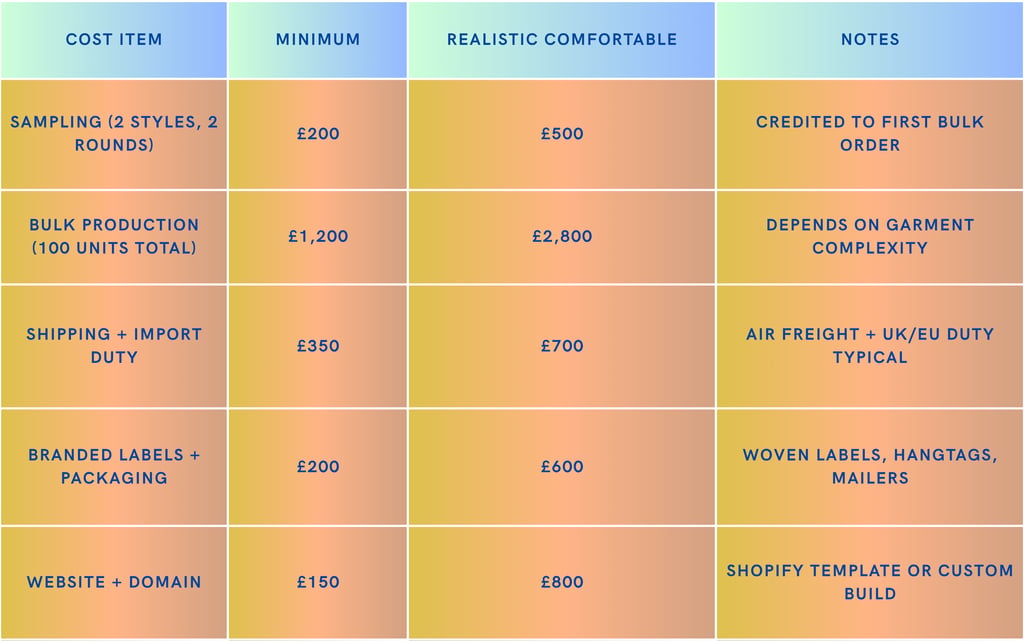
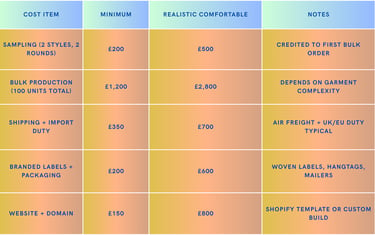
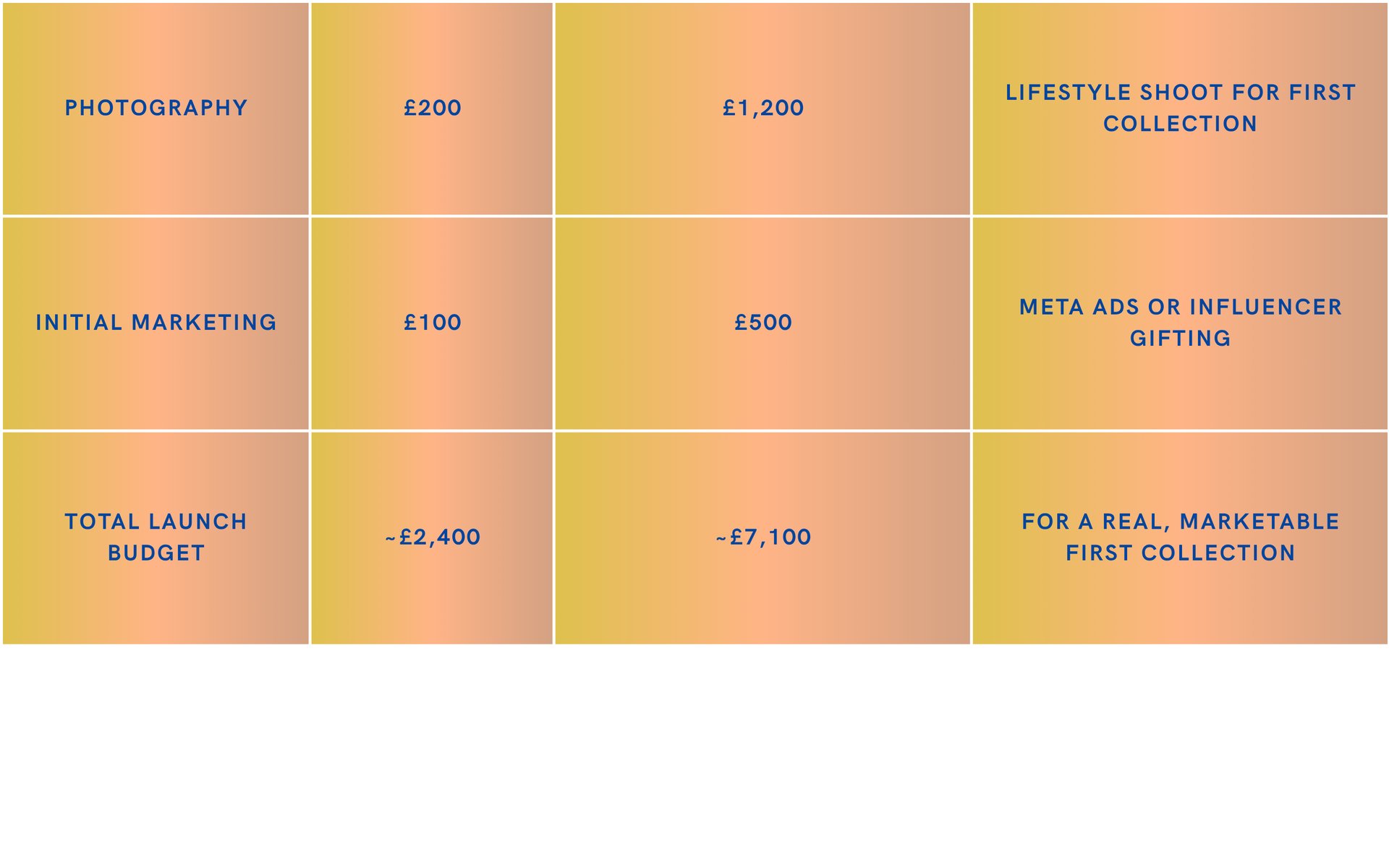
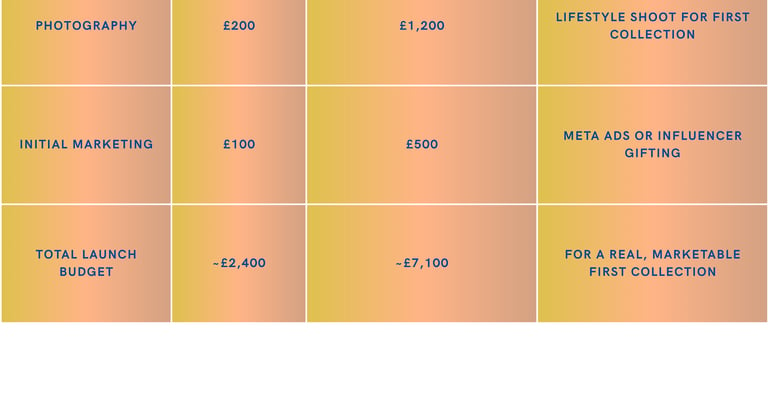
Step 5: Plan Your Finances — What a Clothing Brand Actually Costs to Launch
Step 6: Build Your Brand Identity — What You Actually Need (and What You Don't)
You need: a clear brand name, a simple logo, a consistent colour palette, and a website that loads fast and lets people buy. You do not need, for your first launch: a brand book, a creative agency, a 50-page brand strategy document, or an advertising budget larger than your production investment.
The brand emerges from the product and the story, not the other way around. Your block-printed linen dress from Jaipur with its care label reading "Made by hand by artisans in Rajasthan, India" IS the brand story. Every piece of brand identity should serve to communicate that story clearly, not to replace it.
Step 7: Launch Small, Learn Fast, Scale What Works
The most common mistake new clothing brand founders make is waiting until everything is perfect before launching. There is no perfect launch. There is a first launch, and there is everything you learn from it that makes your second collection better.
Launch your first 100 units. Sell them. Ask every customer what they loved and what they wish was different. Use the money to order your second collection with the improvements you now know to make. This is how clothing brands actually grow — iteration, not perfection.
The best-positioned independent clothing brands in the UK, EU, Australia, and the US were not built in a year. They were built one collection at a time, by founders who started before they felt ready and learned everything important in the process of doing rather than planning.
Where Ashanari Fits Into Your Brand's Journey
If you're building a clothing brand in 2025 — especially if your direction is artisan, sustainable, premium, or simply well-made and honestly priced — Ashanari is built specifically for you. We work with first-time founders who have never placed a manufacturing order alongside established brands on their tenth season. Our low MOQ (50 units per style) means you can start small and grow at the pace your market allows.
We offer in-house block printing, hand embroidery, fabric sourcing, tech pack development support, and private label production — all from our Jaipur workshop — with direct English-language communication, no agents, and no hidden fees. Our full manufacturing services and our step-by-step guide to working with us as a new brand founder will answer most of your remaining questions.
You Know Enough to Start. So Start.
Send us a message with your idea. Your product concept, your target customer, your approximate quantity, and your rough timeline. You don't need a tech pack. You don't need a registered company. You need to send the first message — and we'll tell you exactly what comes next. Most brands who work with us start their first conversation the same way: "I have an idea and I don't quite know where to begin." That's a fine place to start.
Common Questions From Founders Starting Out
How long does it take to launch a clothing brand from scratch?
From your first manufacturer contact to goods in hand, budget 70–100 days for your first order (including sampling). Add 4–8 weeks for website setup, photography, and pre-launch marketing. A realistic first launch timeline from "I have an idea" to "I'm selling" is 4–6 months if you make decisions promptly. Most delays are caused by slow sample feedback, unclear briefs, or indecision at the design stage — not manufacturing.
Do I need a fashion degree to start a clothing brand?
No. Fashion degrees are useful for technical design work (pattern making, construction knowledge, industry connections), but many successful clothing brand founders have no formal fashion education. What you need instead: strong awareness of your target customer, clear aesthetic direction, the ability to communicate your vision in words and images, and a manufacturer who can translate that vision into garments. A good manufacturer compensates for significant gaps in technical knowledge.
Can I start a clothing brand from home?
Yes — and most independent clothing brands begin as home-based businesses. Your manufacturing happens in a factory (not your home). Your design work, brand building, marketing, customer service, and order fulfilment can all happen from a kitchen table, a spare room, or a small home office. You need space to receive and pack stock — the rest is digital. Many of our most successful clients built their first two seasons entirely from home before renting a studio.
What is the cheapest way to start a clothing brand?
The cheapest viable approach: 50 units of one style, produced in a standard fabric with a clean design, from a low-MOQ Indian manufacturer. Total investment: approximately £1,500–£2,500 landed (goods + shipping + duty). Sell those 50 units, prove the market, use the proceeds to fund your second order. This approach minimises capital risk while proving commercial viability before you commit significant funds.
Contact
Reach out for custom orders or questions
call | Whatsapp | email
ashanariindia@gmail.com
Nitin +91-9351612343
Deepti +91-9549123654
Address:
Ashanari Pvt. Ltd.
A-68, Vidhyut Nagar, Ajmer Road, Jaipur,
Rajasthan, India -302021
© 2018. All rights reserved by Ashanari Pvt. Ltd
info@ashanari.com