
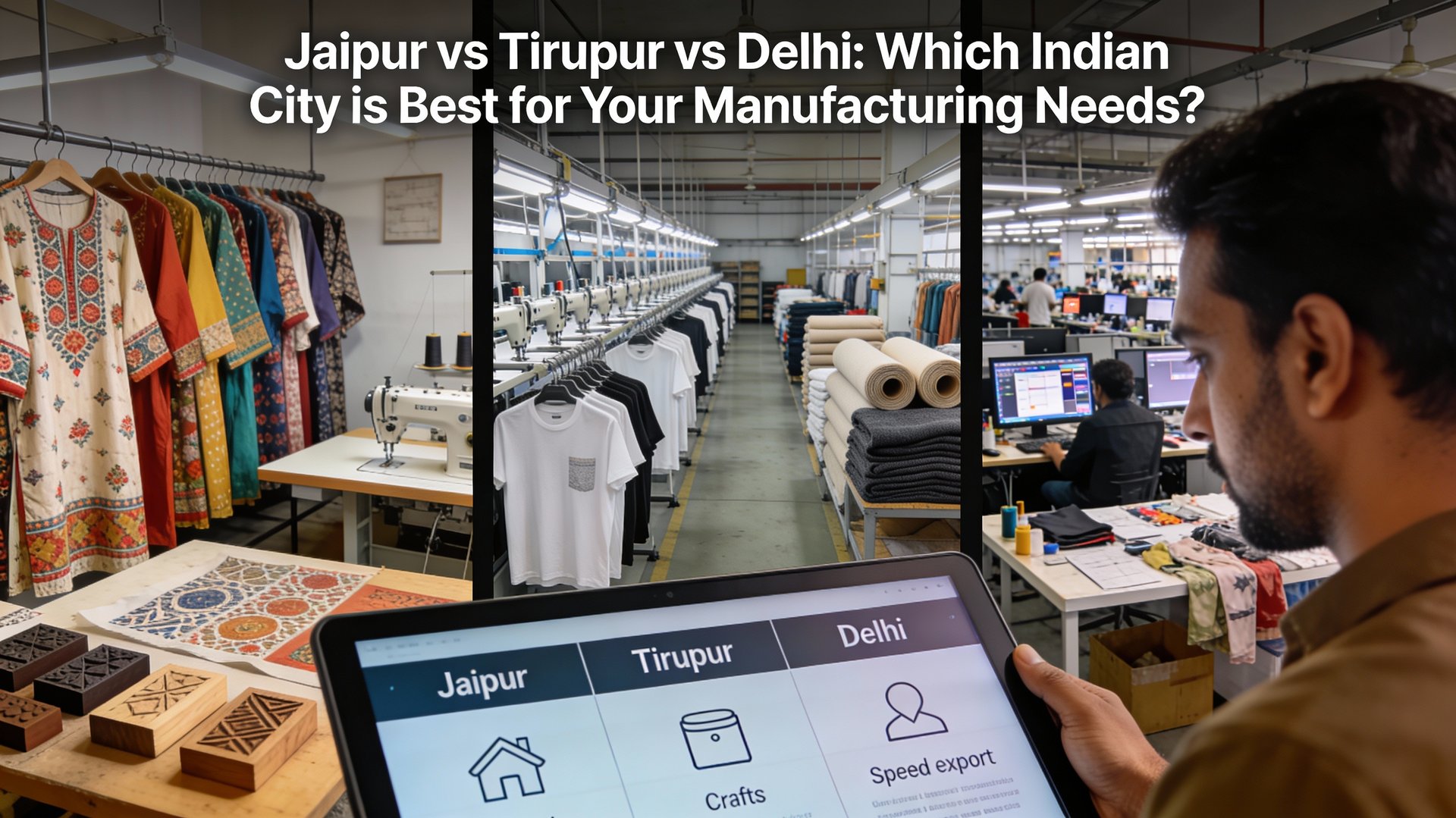
Jaipur vs Tirupur vs Delhi: Which Indian City is Best for Your Manufacturing Needs?
Jaipur vs Tirupur vs Delhi
Ashanari
12/18/20255 min read
Jaipur vs Tirupur vs Delhi: Which Indian City is Best for Your Manufacturing Needs?
Choosing between Jaipur, Tirupur, or Delhi for clothing manufacturing? Complete comparison of costs, specialties, and best uses for each Indian manufacturing hub.
"Should I manufacture in Jaipur, Tirupur, or Delhi?"
This question lands in my inbox at least three times a week.
The answer isn't simple because each city serves different needs. Choosing wrong can cost you 20-40% more and add weeks to your timeline.
After manufacturing in Jaipur for 15 years and working with partners across India, I can tell you: Location isn't just about cost. It's about capabilities, specializations, and what YOUR brand actually needs.
Let me break down each city honestly—including when to choose each and when to avoid them.
The Big Three Overview
Jaipur - The Craft Capital
Heritage: 400 years of textile tradition
Specialties: Hand block printing, embroidery, ethnic wear, artisan techniques
Vibe: Traditional meets modern
Key stats: 50,000+ artisans, 3,000+ manufacturing units
Best for: Brands wanting unique, handcrafted elements
Cost level: Moderate (₹400-₹1,500 per piece depending on complexity)
Tirupur - The Knit Hub
Known as: "India's Knitwear Capital"
Specialties: T-shirts, polo shirts, activewear, basics, jersey fabrics
Vibe: High-volume, efficiency-focused
Key stats: ₹50,000 crore annual turnover, exports to 100+ countries
Best for: Volume orders, basics, consistent quality at scale
Cost level: Most competitive (₹150-₹600 per piece)
Delhi NCR - The Versatile Giant
Includes: Delhi, Noida, Gurgaon, Faridabad, Ghaziabad
Specialties: Everything - variety is the specialty
Vibe: Fast-paced, commercial, accessible
Key stats: Largest garment manufacturing hub by value
Best for: Quick sampling, diverse product lines, high-fashion
Cost level: Highest (₹500-₹2,000+ per piece)
What Jaipur Does Best:
Hand block printing (Jaipur, Sanganer, Bagru techniques)
Hand embroidery (zari, gota patti, aari work)
Ethnic wear (kurtas, lehengas, sarees, fusion wear)
Natural dyeing and sustainable textiles
Handloom integration
Jaipur's Competitive Advantages:
Artisan skills passed through generations
Unique products (can't be replicated by machines)
Premium pricing opportunity (craft commands higher prices globally)
Sustainable/ethical story (hand-made, traditional)
Tourist-friendly (easy to visit and verify)
When to Choose Jaipur:
Your brand focuses on craft, heritage, artisan techniques
Selling to Western markets that value "made by hand"
Ethnic wear or fusion clothing
Premium positioning (₹50-₹150 retail price points)
Smaller batches (30-100 pieces) acceptable
Want unique selling proposition
When NOT to Choose Jaipur:
Need basic t-shirts/hoodies (not our strength)
Volume orders 5,000+ pieces (other cities more efficient)
Extremely tight deadlines (craft takes time)
Budget basics with rock-bottom pricing
Pure activewear/performance fabrics
Jaipur Cost Breakdown (Real Examples):
Basic cotton kurta (no print): ₹400-₹600
Hand block print dress (single color): ₹800-₹1,200
Multi-color block print with embroidery: ₹1,500-₹2,500
Custom ethnic fusion piece: ₹2,000-₹4,000
Timeline Expectations:
Sampling: 7-10 days (craft can't be rushed)
Small batch (50-100): 25-30 days
Medium batch (200-500): 30-40 days
Busy seasons: Add 10-15 days (Diwali prep: Aug-Oct)
Ashanari's Jaipur Advantage:
15 years specializing in Jaipur crafts
Direct artisan relationships
Hand block printing in-house
Western sizing expertise for ethnic wear
Quality control for international standards
What Tirupur Does Best:
Knit fabrics (jersey, rib, pique, fleece)
T-shirts (every style imaginable)
Polo shirts
Activewear (gym wear, yoga wear, athleisure)
Innerwear
Children's basic wear
High-volume production
Tirupur's Competitive Advantages:
Economies of scale (price drops significantly at volume)
Speed (can produce 10,000 pieces faster than others)
Export infrastructure (experienced with international shipments)
Vertical integration (spinning to finishing in one place)
Quality consistency (standardized processes)
When to Choose Tirupur:
Ordering basics (t-shirts, tanks, leggings, shorts)
Volume: 500+ pieces minimum
Cotton or synthetic knits
Activewear/athleisure brand
Need very competitive pricing
Exporting large quantities
Consistent repeat orders
When NOT to Choose Tirupur:
Small batches (under 200 pieces) - won't get good pricing
Woven fabrics (their specialty is knits)
Hand-crafted elements
Quick small sampling (geared for production, not sampling)
Highly customized, one-off pieces
Formal wear or tailored garments
Tirupur Cost Breakdown:
Basic cotton t-shirt (200 pcs): ₹150-₹250
Same t-shirt (1000 pcs): ₹100-₹180
Polo shirt (500 pcs): ₹250-₹400
Activewear leggings (500 pcs): ₹300-₹500
Sports bra (1000 pcs): ₹200-₹350
Timeline Expectations:
Sampling: 10-15 days
Small batch (500 pcs): 20-25 days
Large batch (5000 pcs): 30-40 days
Incredibly fast turnaround for repeat orders
Tirupur Considerations:
Language: More Tamil speakers, less English comfort (compared to Delhi/Jaipur)
MOQ: Usually firm on minimums
Customization: Limited (focused on efficiency, not uniqueness)
Best for: Established brands with proven SKUs
What Delhi Does Best:
Everything and anything
Quick sampling across product types
High fashion and contemporary design
Bridal wear and occasion pieces
Mix of traditional and modern
One-stop shopping (can source multiple product types)
Delhi's Competitive Advantages:
Accessibility (international airport, easy to visit)
Speed (fastest sampling in India)
Variety (every type of manufacturer within 50km)
Network effects (fabric markets, trim suppliers all nearby)
Communication (more English speakers, business-savvy)
Quality range (from budget to ultra-premium)
When to Choose Delhi:
Need to sample quickly
Diverse product line (dresses + pants + jackets)
High-fashion or trend-focused brand
Prefer face-to-face interaction
Complex, multi-component garments
Formal wear, suits, tailored pieces
Bridal or occasion wear
Want to visit manufacturer easily
When NOT to Choose Delhi:
Extremely price-sensitive (Delhi is most expensive)
Very large volume (other cities more efficient)
Basic knits (Tirupur cheaper)
Traditional craft focus (Jaipur better)
Don't need speed/variety (paying premium for these)
Delhi Cost Breakdown:
Basic dress: ₹600-₹1,000
Formal blazer: ₹1,500-₹3,000
Bridal lehenga: ₹5,000-₹20,000+
Contemporary fusion wear: ₹800-₹2,000
Tailored suit: ₹2,000-₹5,000
Timeline Expectations:
Sampling: 5-7 days (fastest in India)
Small batch (100 pcs): 15-25 days
Medium batch (500 pcs): 25-35 days
Rush orders: Possible (at premium cost)
Delhi Sub-Regions:
Noida: Modern factories, better infrastructure, export-focused
Gurgaon: High-end fashion, contemporary brands
Okhla: Diverse range, mid-market
Faridabad: Larger production units
Create table comparing:
FactorJaipurTirupurDelhiBest ForEthnic/craftKnits/basicsVariety/speedSpecialtyBlock print/embroideryT-shirts/activewearEverythingMOQ30-75 pcs500-1000 pcs50-500 pcsCost LevelModerateLowestHighestSpeed (sampling)7-10 days10-15 days5-7 daysSpeed (bulk 500)30-40 days20-25 days25-35 daysFabric TypeWovens/naturalKnits/syntheticBothCustomizationHighLowMedium-HighExport ExperienceGrowingExtensiveExtensiveCommunicationGood EnglishSome barriersBest EnglishIdeal Order Size50-500500-5000+50-1000
Case Study 1: Ethnic Fusion Brand (Chose Jaipur) ✓
Brand: London-based, selling Indian-inspired dresses to UK market
Why Jaipur: Hand block printing was their USP
Results: Premium pricing (£85-120 per dress), strong differentiation
Key learning: Craft justified higher retail price
Case Study 2: Activewear Startup (Chose Tirupur) ✓
Brand: Australian gym wear brand
Why Tirupur: Volume needs (1000+ pieces), competitive pricing
Results: Profitable margins, fast restocks
Key learning: Economies of scale crucial for activewear
Case Study 3: Contemporary Fashion (Chose Delhi) ✓
Brand: Mumbai-based, trend-focused womenswear
Why Delhi: Quick sampling, variety, fast fashion model
Results: Can test 10 designs, scale only winners
Key learning: Speed to market worth the premium
Case Study 4: Wrong City Choice (Lesson) ✗
Brand: Ordered basics from Jaipur (should've chosen Tirupur)
Mistake: Paid 40% more for simple t-shirts
Results: Couldn't compete on price
Lesson: Match city to product type
Emerging Hubs to Watch
Bangalore:
Growing tech-enabled manufacturing
Good for startups, modern processes
Higher costs but professional
Ludhiana:
Winterwear specialist
Woolens, jackets, knitwear
Good for cold-weather clothing
Kolkata:
Growing fashion hub
Reasonable costs
Less explored, good potential
Surat:
Fabric capital
If you handle production, great for fabric sourcing
Synthetic specialty
How to Decide
Decision Framework:
Step 1: Define Your Product
What exactly are you making?
Basic or craft-heavy?
Knit or woven?
Volume needed?
Step 2: Identify Your Priorities
Cost most important? → Tirupur
Speed most important? → Delhi
Uniqueness most important? → Jaipur
Step 3: Consider Your Business Model
DTC with fast fashion? → Delhi
Wholesale with proven SKUs? → Tirupur
Premium artisan brand? → Jaipur
Step 4: Match Minimum Orders
Under 100 pcs? → Jaipur or Delhi
500-1000 pcs? → Any city
5000+ pcs? → Tirupur
Decision Tree: → Need craft/ethnic? → Jaipur → Need basics/knits at volume? → Tirupur
→ Need variety/speed? → Delhi → Need formal/tailored? → Delhi or Jaipur → Need best price? → Tirupur → Need quick samples? → Delhi
Working with Multiple Cities
Hybrid Strategy:
Some brands use different cities for different products
Example: Craft pieces from Jaipur, basics from Tirupur
Pros: Optimize each product type
Cons: Managing multiple partners
When it works: Larger brands with diverse product lines
CONCLUSION
There's no "best" city universally
Best = what matches YOUR needs
Don't choose on cost alone
Right city = smooth production, better results
Can always switch cities as you grow
Many brands start one city, expand to others
Final Recommendations:
First-time brands: Start with Jaipur or Delhi (lower MOQs, more hand-holding)
Volume brands: Tirupur (efficiency and cost)
Premium brands: Jaipur (craft is your USP)
Fast-fashion: Delhi (speed matters)
CALL TO ACTION
Ashanari's Jaipur Advantage
Specializing in Jaipur crafts for 15 years
Also have Delhi and Tirupur network partnerships
Can guide you to right city based on YOUR product
Or handle multi-city coordination for you
Contact: Ashanariindia@gmail.com | www.ashanari.com | +91-9549123654
Contact
Reach out for custom orders or questions
call | Whatsapp | email
ashanariindia@gmail.com
Nitin +91-9351612343
Deepti +91-9549123654
Address:
Ashanari Pvt. Ltd.
A-68, Vidhyut Nagar, Ajmer Road, Jaipur,
Rajasthan, India -302021
© 2025. All rights reserved with ashanari pvt ltd
info@ashanari.com