
Minimum Order Quantities in India: How Small Can You Really Start (Without Getting Ignored)?
Minimum Order Quantities in India
Ashanari
12/19/20256 min read
Minimum Order Quantities in India: How Small Can You Really Start (Without Getting Ignored)?
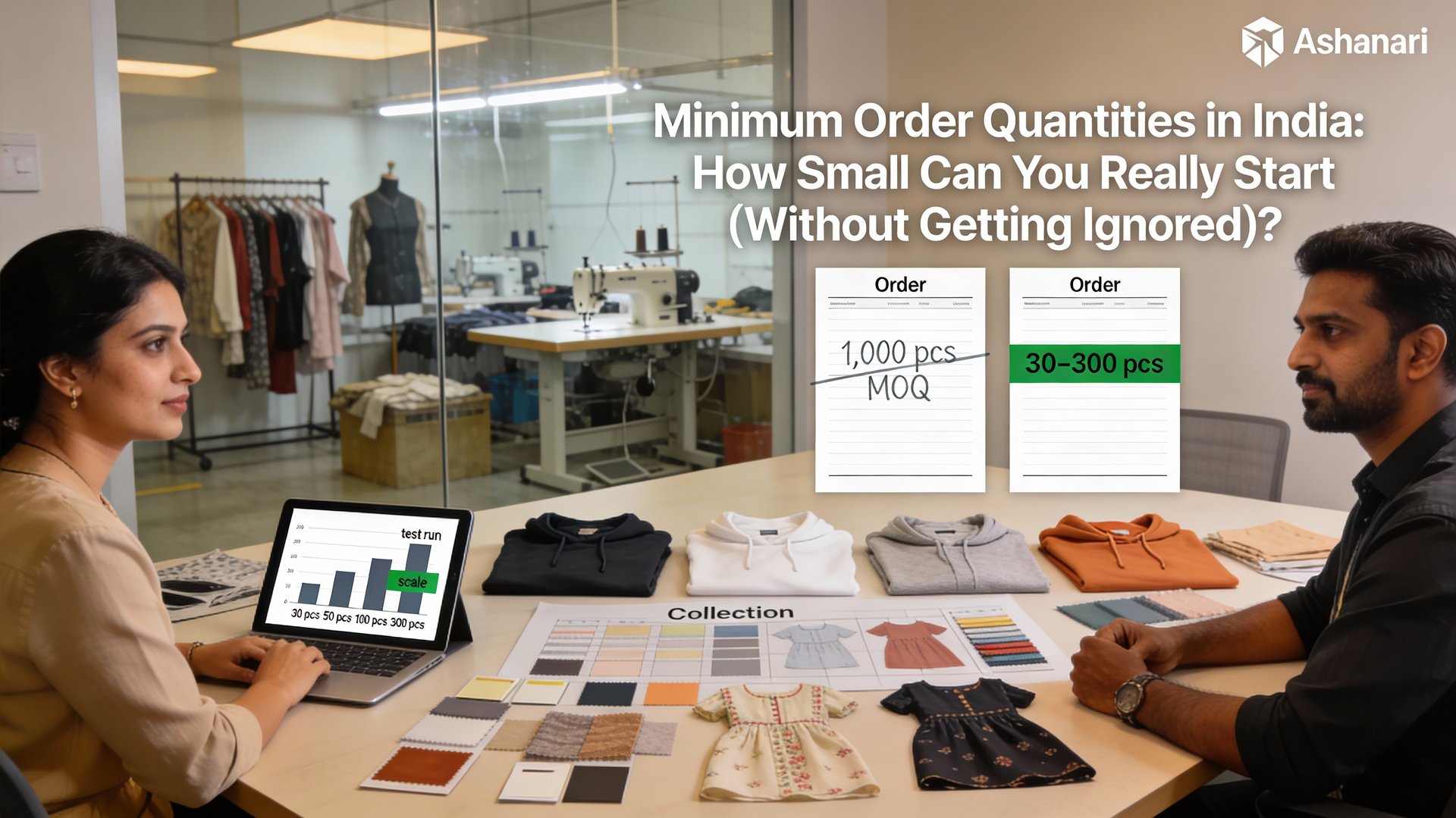
When most new brands start talking to factories in India, the first roadblock they hit is a single scary phrase: “Our MOQ is 1,000 pieces per style.”
For many serious but small brands, that number feels impossible—and they assume India is “only for big players”.
The truth is more nuanced. If you understand where MOQs actually come from (fabric mills, printing, stitching lines) and how to structure your first collection, you can start much smaller—often 30–300 pieces per style—without being treated like an unimportant client.
This guide breaks down how MOQs really work in India, what’s realistic for small and upcoming brands, and how to negotiate smarter instead of just asking “Can you do lower MOQ?”
Why MOQ Is Not Just a “Factory Being Difficult”
Minimum order quantity is not a random number manufacturers invent to annoy you.
It is usually a combination of:
Fabric minimums from mills and wholesalers
Setup costs for printing, dyeing, embroidery, washing
Line efficiency and how often a factory can switch styles
The risk of stocking leftover fabric and trims for tiny brands that may never reorder
If you are launching a new brand and only want 30–80 pieces per design, the factory’s problem is simple: the work is the same to set up, but the invoice is much smaller. If they do not specialize in small batches, it is not worth their time.
Your job is to structure your order so that it works commercially for both sides.
Where MOQs Really Come From in India
1. Fabric Mills and Converters
Most mills have minimums for weaving, dyeing, or printing a fabric.
Common patterns in India:
Solid dyed knits (t‑shirt/hoodie fabrics): 80–200 kg per color
Woven solids: 100–300 meters per color
Printed fabrics (screen/rotary): 300–1,000 meters per design per color
For a simple example:
A midweight cotton for t‑shirts may require 100 kg minimum per color.
If each t‑shirt uses ~0.2–0.25 kg, you are looking at roughly 400–500 t‑shirts per color to fully utilize that dye lot.
If you only need 80 t‑shirts, somebody is absorbing the leftover fabric—either:
The mill (rare)
The factory (risky for them)
Or you (most common)
This is why you often hear, “MOQ 300–500 pieces per color.” It is actually a fabric issue, not a stitching issue.
2. Printing and Embroidery Setups
Any process that requires setup has a natural MOQ, because the setup cost gets divided over the number of pieces.
Screen printing: Each color requires a screen and setup.
Rotary or table printing: Screens/rollers, strike‑offs, color matching.
Embroidery: Digitizing charges, thread setup, machine time.
If screens cost ₹2,000–₹4,000 per color, and you want a 3‑color chest print on just 30 t‑shirts, your per‑piece print cost becomes very high.
For 300 t‑shirts, the same setup cost spreads out, and the factory can give you a more reasonable rate.
3. Line Efficiency and Style Switching
Garment factories are set up as assembly lines.
When they switch from one style to another:
Machines need different threads/attachments.
Workers need to adjust operations.
Line balancing changes.
If a line is changed too frequently for very tiny runs, efficiency drops and costs rise sharply.
That is why factories usually ask for a minimum number per style or per production run.
Realistic MOQ Ranges in India (By Product Type)
These are typical ranges seen when working with factories that are willing to handle small and medium brands. Actual numbers vary, but this gives you realistic expectations.
Knits: T‑shirts, Hoodies, Sweatshirts
Tirupur, Delhi NCR, some Bangalore units
Common MOQ for serious small brands:
50–100 pieces per style per color if fabric is stock/ready
200–300 per color if fabric is dyed specially for you
Ethnic, Fusion, Dresses, Co‑ords
Jaipur, Delhi NCR, parts of Mumbai
Common MOQ:
30–60 pieces per style if fabric is sourced from existing prints/solids
80–150 per style per color if custom print or special fabric is made
Export‑oriented Western Apparel
Dresses, blouses, resortwear, lounge sets
Common MOQ:
80–150 pieces per style per color for proper export lines
Sometimes lower (50–80) if using stock fabrics and a small‑batch specialist
If someone tells you “we only do 1,000+ per style”, it usually means they are set up for large‑volume clients and are not the right type of factory for a new brand—not that India itself cannot do small batches.
Indian vs International Expectations on MOQ
Indian Brands
Indian founders launching on Myntra, Ajio, or Instagram often:
Want 30–80 pieces per design
Want multiple colors and sizes
Need flexibility to test designs before scaling
Good small‑batch factories in India understand this and may:
Allow 30–60 pcs per design if you use their recommended fabrics
Combine your order with other clients’ fabric buys
Help you build a capsule of 3–6 styles to make the run worthwhile
International Brands
Overseas clients tend to:
Expect Western fits and more detailed finishing
Ship internationally, so small quantities become expensive per piece
Often start with 50–100 pcs per style to test demand
From a factory perspective, international orders require:
Export documentation
Compliance and packaging to destination standards
More communication and sampling
So the MOQ is often slightly higher than for a local Indian brand unless the factory is specifically focused on small‑batch export.
Smart MOQ Strategies for Serious but Small Brands
Instead of fighting for “lowest MOQ possible”, the goal is to make your first order efficient and scalable.
1. Bundle Styles Around a Common Base
Instead of 4 totally different patterns:
Use 1 core body (for example, an oversized t‑shirt or a straight kurta).
Create 3–4 variations with print, color, or minor design changes.
This way:
Pattern and grading costs are shared.
Production setup is simpler.
You can often get a better MOQ deal across the whole capsule.
2. Reuse Patterns Across Seasons
Once you develop a good pattern:
Use it again in new fabrics or prints next season.
You avoid fresh pattern/grading costs and can negotiate lower MOQs on repeat.
This is how big brands operate quietly: they don’t reinvent the wheel every season; they reuse winning blocks.
3. Work with Stock Fabrics for the First Drop
If you insist on:
Custom weaving
Custom dye
Custom print
…your MOQ will shoot up.
For your first collection, consider:
Using high‑quality stock fabrics your manufacturer already works with
Doing your custom designs through print/embroidery on top of that
You get lower MOQs and faster timelines.
4. Think in Terms of “Production Run”, Not Just “Per Style”
Many factories think in terms of:
“Is this run big enough to keep a line busy for some days?”
You can often:
Combine 2–4 styles in the same run
Share fabrics across styles
Hit a total run of 150–300 pieces while keeping each style around 30–80 pieces
This makes your order commercially attractive without forcing you into 1,000 pcs of a single design.
Common MOQ Mistakes New Brands Make
Asking for 10–20 pcs per style with full customization
This is sampling, not production, and will be priced like it.
Changing designs constantly
Every change means new patterns, new fabric, new setups = higher effective MOQ.
Not sharing a roadmap
If the factory only sees “one small order”, they quote protective MOQs.
If you show a 6–12 month plan, they are more willing to support small starts.
Ignoring fabric logic
Focusing only on “pieces” without understanding meters, kg, or dye lot minimums.
How Ashanari Handles MOQs for New and Growing Brands
At Ashanari in Jaipur, the focus is specifically on helping small and upcoming brands—both Indian and international—start realistically and scale intelligently.
Typical approach:
Starting MOQs from 30–50 pieces per style for suitable categories (especially ethnic/fusion and select westernwear)
Guiding you toward fabrics and constructions that keep MOQs and cost under control
Bundling multiple styles into a single production run where possible
Recommending capsule collections instead of disconnected designs
For export‑oriented brands, the focus is on:
Western sizing and fit from the beginning
Packaging and labeling that meet destination expectations
Planning quantities that make sense with air/sea shipping economics
The goal is not to push you into risky large orders, but to help you:
Test 30–80 pieces
Learn from real customers
Then reorder 150–300 pieces of what actually sells
Instead of asking factories, “What is your MOQ?”, a better conversation is:
“Here are my 3–6 styles, target price, and total budget.
How can we structure fabric, patterns, and production so I can start with small but serious quantities and still be a good client for you?”
If you share:
Product type (t‑shirts, hoodies, kurtas, dresses, co‑ords, etc.)
Target markets (India / international)
Budget and rough quantities
Ashanari can help map out:
A realistic MOQ per style
A smart first collection structure
And a clear path from 30–50 pieces today to 300+ pieces tomorrow.
Contact
Reach out for custom orders or questions
call | Whatsapp | email
ashanariindia@gmail.com
Nitin +91-9351612343
Deepti +91-9549123654
Address:
Ashanari Pvt. Ltd.
A-68, Vidhyut Nagar, Ajmer Road, Jaipur,
Rajasthan, India -302021
© 2018. All rights reserved by Ashanari Pvt. Ltd
info@ashanari.com