

🇺🇸
Written for USA Brands
Private Label Clothing for USA Brands: Why Sourcing from India Is the Smart Move in 2025
If you're building a clothing brand in the United States right now, the manufacturing question has never been more consequential — or more politically complicated. Section 301 tariffs on Chinese goods, unpredictable trade policy shifts, and growing consumer demand for traceable, non-Chinese supply chains have fundamentally changed the calculus of where American fashion brands should manufacture.
India — and specifically Jaipur — has emerged as the answer for a growing cohort of US startup brands, DTC fashion labels, and independent designers who need low MOQ production, quality they can stand behind, and a supply chain that doesn't carry the geopolitical risk of the last decade of China-centric manufacturing.
This guide is written specifically for US brand founders: the tariff context, the logistics reality, the cost comparison, and why Jaipur's artisan manufacturing ecosystem is a better fit for the US premium fashion market than most founders realise.
🇮🇳
Manufactured in Jaipur
🗽
New York · LA · Chicago
The Tariff Context: Why India Now Has a Material Advantage Over China
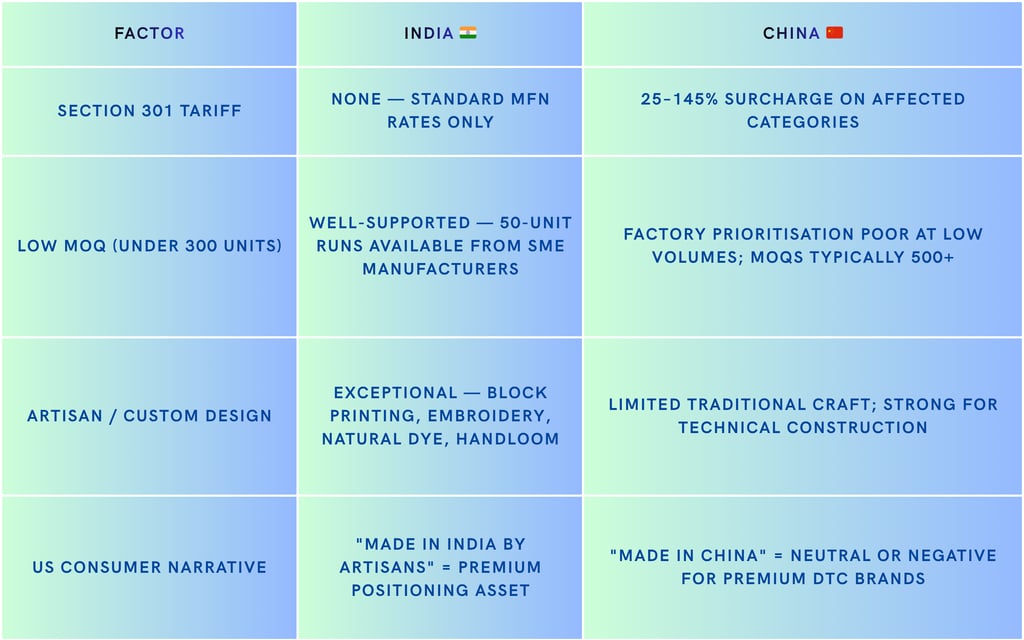
Section 301 tariffs — applied to Chinese goods under the Trump administration and maintained and expanded under subsequent administrations — have added 25–145% to the cost of many Chinese-manufactured garment categories for US importers. In 2025, these tariffs remain largely in place, and the prospect of their removal is uncertain at best.
India is not subject to Section 301 tariffs. Indian-manufactured clothing enters the United States under standard Most Favoured Nation (MFN) duty rates, which range from 0% to approximately 32% depending on garment type and fibre composition — without the Section 301 surcharge. For US brands importing comparable garments from China, the effective duty rate can be 40–60% higher than the equivalent Indian import.
25–145%
Section 301 tariff surcharge on Chinese textiles (2025)
0%
Section 301 surcharge on Indian textiles
25–30
Days sea freight, Jaipur → US East Coast
5–7
Days air freight, Jaipur → US major cities
Note for US buyers: Always verify the applicable HTS (Harmonised Tariff Schedule) code for your specific garment category with a US-licensed customs broker before placing large orders. Duty rates for clothing vary significantly by fibre content, construction, and end use. The figures above are indicative — your specific product may attract different rates.
US Import Logistics: What You Actually Need to Know
Shipping from Jaipur to the USA
Jaipur exports regularly to major US ports (Los Angeles, Long Beach, New York/Newark, Savannah). The logistics infrastructure is well-established:
Air freight: Jaipur → Delhi Indira Gandhi Airport → US gateway (JFK, LAX, ORD). Transit time: 5–8 days. Cost: approximately $5–$9 per kg. Suitable for samples, urgent reorders, and high-value small runs.
Sea freight (FCL/LCL): Jaipur → JNPT Mumbai or Mundra Port → US West Coast (LA/Long Beach: 18–22 days) or US East Coast (24–30 days). Cost: $85–$160 per CBM for LCL. Sea freight is the commercial choice for bulk production runs.
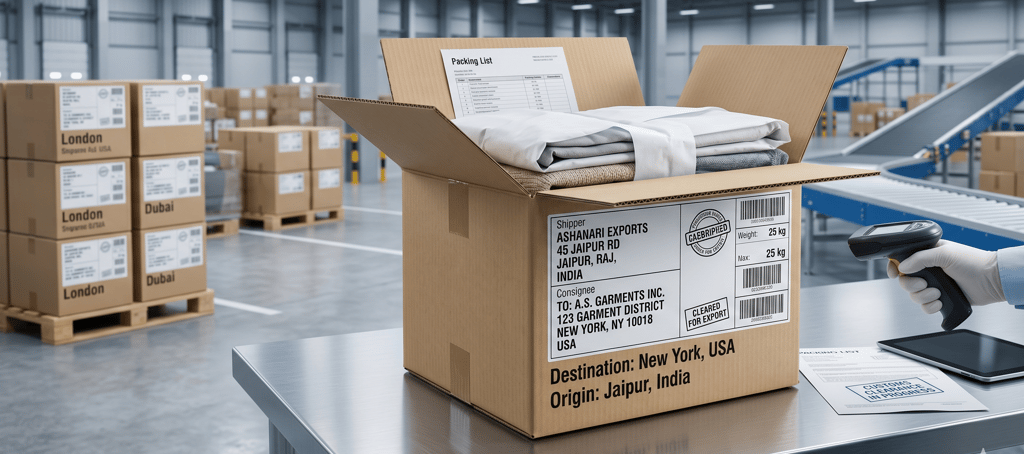
DDP (Delivered Duty Paid): Ashanari can arrange DDP shipping to major US cities, handling all export documentation, ocean/air freight, US customs clearance, and final mile delivery. This simplifies the import process significantly for US brands placing their first international orders.
US Customs Documentation
Required for every India-to-USA textile shipment:
Commercial Invoice with declared value (USD), HTS code, country of origin, and fibre content
Packing List with carton dimensions and weights
Bill of Lading or Air Waybill
Certificate of Origin (India) — required to confirm country of origin for tariff purposes
For children's clothing: CPSC compliance documentation and applicable safety test reports (California Prop 65 may also apply)
The US Fashion Market Opportunity That India Is Built For
The US independent fashion market has specific characteristics that align particularly well with what Indian artisan manufacturing offers:
The DTC Premium Brand Segment
US DTC clothing brands selling $100–$250 garments — the Everlane, Mara Hoffman, Christy Dawn segment — are the natural home for Indian artisan production. Consumers in this segment actively research where their clothing is made, what the artisans are paid, and whether the materials are responsibly sourced. "Handmade in India by artisan craftspeople" is a narrative that this buyer actively rewards with their purchasing decision.
The Boutique Wholesale Segment
US boutique buyers — the buyers for small multi-brand retailers across New York, Los Angeles, Austin, Nashville, and the independent retail ecosystem — are consistently looking for differentiated products that their customers can't find on Amazon or ASOS. Block-printed Indian garments, handloom textiles, and artisan embroidery are consistently among the highest-performing categories for US boutique inventory precisely because they can't be replicated at low cost by the machine-made alternatives.
The Sustainable Fashion Segment
US consumers are willing to pay more for sustainably produced clothing — and verifiably so. Nielsen's 2024 data shows US consumers under 40 willing to pay a 22% premium for clothing from certified sustainable supply chains. India's organic cotton sector and artisan production ecosystem provide the supply chain credentials that this customer demands and that US brands need to compete in this segment. Read our full guide on sustainable clothing manufacturing in India for a detailed breakdown of certifications and practices.
India vs China for US Brands: The 2025 Reality
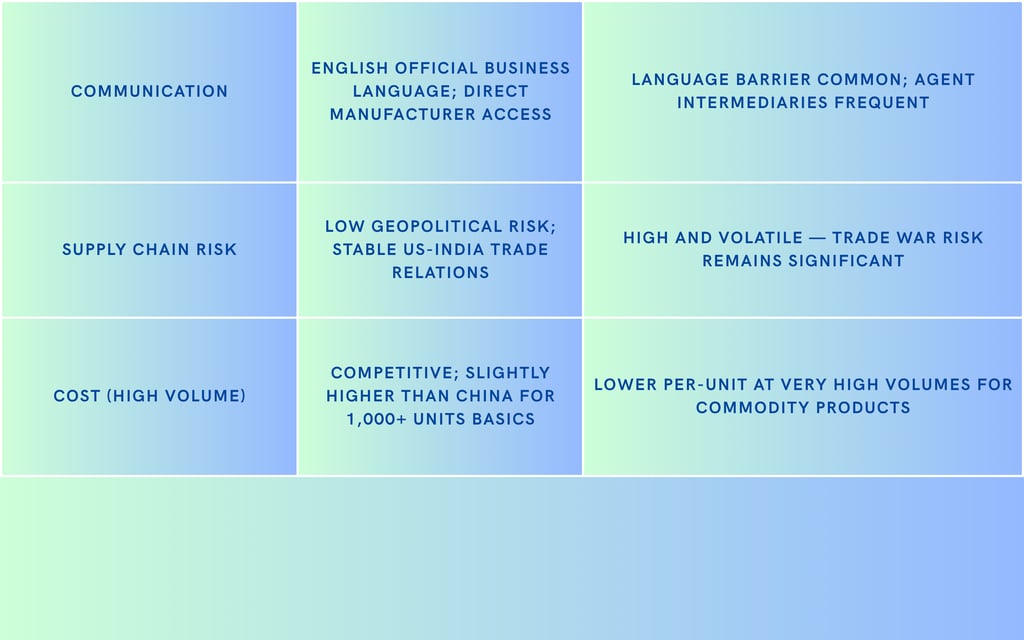
What US Brands Are Building with Jaipur Manufacturing
The US brands successfully sourcing from Jaipur span a wide range of aesthetics and price points. Common success profiles include:
Sustainable DTC labels selling handcrafted linen and organic cotton at $150–$350 retail
Boho and artisan lifestyle brands building Instagram-driven audiences around Indian craft textiles
Small wholesale brands supplying US boutique chains with authentic block print and embroidery collections
Private label brands building differentiated product for Amazon Handmade or specialty retail with Indian artisan positioning
Why Ashanari for US Brands
At Ashanari, we have worked with US brand founders from New York, Los Angeles, Austin, Denver, and beyond. We understand the US import process, DDP shipping to US addresses, and what US boutique buyers and DTC customers expect from their clothing in terms of quality, label, and story.
We offer low MOQ from 50 units, private label manufacturing with your branding and labels, in-house block printing and embroidery, organic and conventional fabric options, and direct communication — no agents, no mystery, no translated misunderstandings. Our full manufacturing services page details everything available. For a detailed cost estimate for your specific product, read our 2025 India manufacturing cost breakdown.
US Brand? India Manufacturing Has Never Made More Sense.
Tell us about your collection: product types, quantities, aesthetic direction, and target retail price. We'll respond within 24 hours with an honest production proposal — real costs, real timelines, real answers.
Private Label Clothing Manufacturer USA Brands | India 2025
US fashion brands: discover why sourcing private label clothing from India beats China in 2025: better tariff position, low MOQ, artisan quality, and direct communication. private label clothing manufacturer usa
REGIONAL GUIDES
Ashanari International Sales Team
4/28/20265 min read
Contact
Reach out for custom orders or questions
call | Whatsapp | email
ashanariindia@gmail.com
Nitin +91-9351612343
Deepti +91-9549123654
Address:
Ashanari Pvt. Ltd.
A-68, Vidhyut Nagar, Ajmer Road, Jaipur,
Rajasthan, India -302021
© 2025. All rights reserved with ashanari pvt ltd
info@ashanari.com