

Western Sizing vs Indian Sizing: The £15,000 Mistake (And How to Avoid It)
Western Sizing vs Indian Sizing
12/17/202511 min read
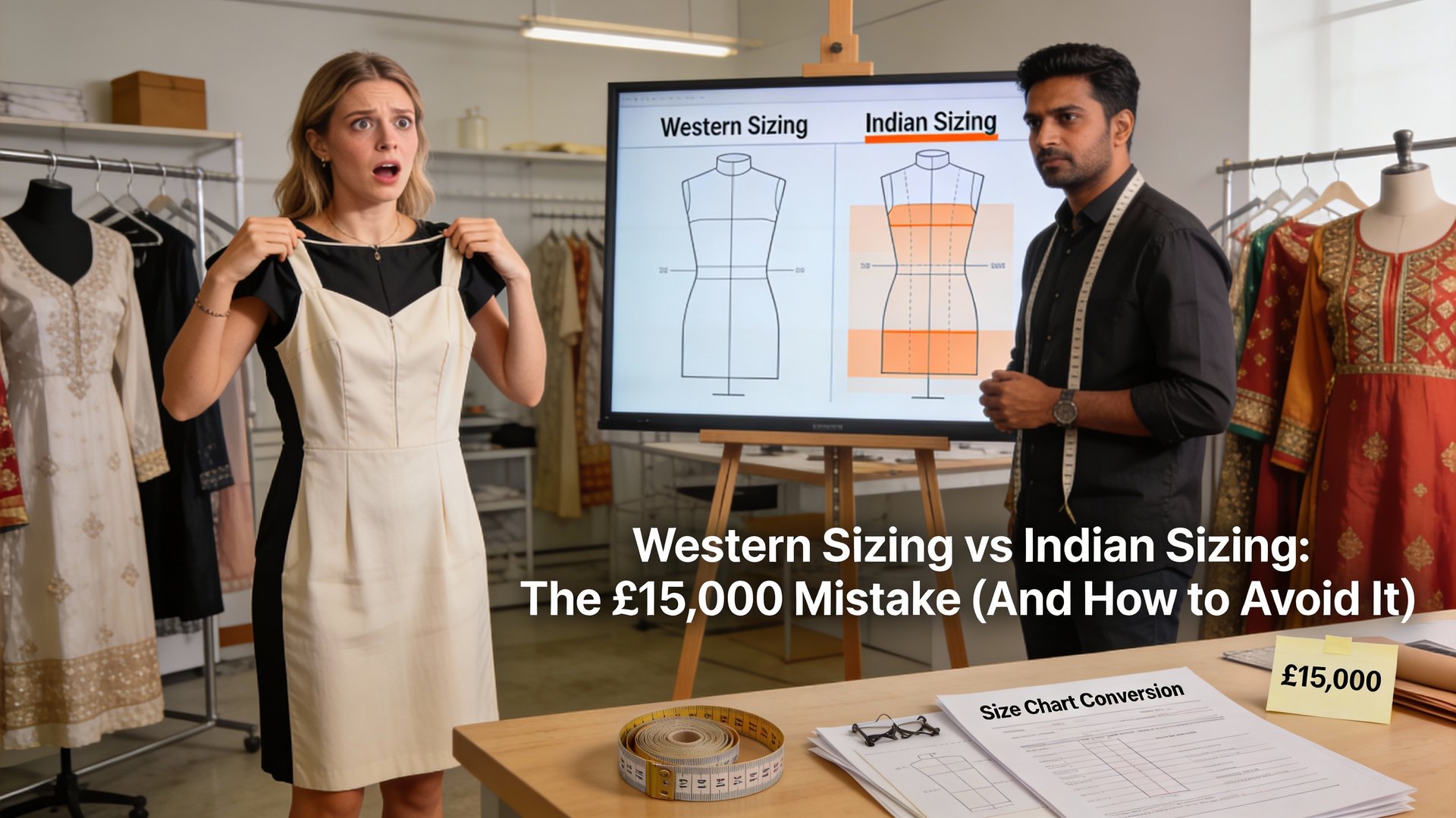
Western Sizing vs Indian Sizing: The £15,000 Mistake (And How to Avoid It)
"Size medium in India fit like a small in the UK. Every. Single. Piece."
Emma from Birmingham learned this the hard way. She ordered 500 "size medium" dresses from an Indian manufacturer. Perfect samples. Enthusiastic launch. Excited customers.
Then the returns started.
"Too tight in the bust." "Sleeves too short." "Can't zip it up." "Feels like I ordered the wrong size."
Emma's £12,000 order became £3,400 in returns, £1,800 in reshipping, £2,100 in discount codes to apologize, and £6,500 to remanufacture correct sizes.
Total loss: £13,800. Plus three months of delays. Plus damaged brand reputation.
The worst part? This was 100% preventable.
The problem wasn't the manufacturer's quality. It wasn't miscommunication. It wasn't bad luck.
The problem was assuming "medium" means the same thing everywhere.
Why This Happens (And Why It's So Common)
Here's what most new brands don't realize: There is no universal sizing standard for clothing.
Not within countries. Definitely not across countries.
The Reality:
A US size 8 = UK size 12 = EU size 40 = India size L
But even that's not consistent across brands
Indian brands often use different base measurements than Western brands
"Medium" in Mumbai ≠ "Medium" in Manchester
According to a 2024 study by the Fashion Sizing Institute:
72% of returned clothing globally is due to fit/size issues
For international manufacturing, that number jumps to 84%
Average cost of a sizing error: £18-35 per piece (returns + restocking + customer service)
For a 500-piece order, that's a potential £9,000-17,500 loss.
The Core Problem: Different Body Types, Different Standards
Indian Sizing Standards (as commonly used):
Indian clothing manufacturers typically work with measurements based on:
Smaller frame average: Indian market averages are based on smaller-framed body types
Less height allowance: Average height considerations are often 5'2"-5'5" for women, 5'6"-5'9" for men
Different proportion emphasis: More fitted at waist/bust, less at shoulders/hips
Conservative fit preference: Indian market generally prefers more coverage, less body-conscious fits
Western Sizing Standards (US/UK/EU/Australia):
Western markets typically assume:
Larger frame average: Based on larger-framed populations
Taller height assumption: 5'4"-5'7" for women, 5'9"-6'0" for men
Different proportion distribution: More room in shoulders, hips, less at waist
Varied fit preferences: More body-conscious fits common, athleisure influence
The Real Comparison: Size Chart Truth
Here's the reality of how Indian sizing typically compares to Western sizing:
WOMEN'S SIZING: India vs Western
India SizeBust (inches)WaistHip= UK Size= US Size= EU SizeXS30-3224-2634-364-60-232-34S32-3426-2836-386-82-434-36M34-3628-3038-408-104-636-38L36-3830-3240-4210-126-838-40XL38-4032-3442-4412-148-1040-42XXL40-4234-3644-4614-1610-1242-44
Key Differences:
Indian "Medium" = Western "Small"
Indian "Large" = Western "Medium"
Indian "XL" = Western "Large"
But here's where it gets messy: Not all Indian manufacturers use these conversions. Many assume their "Medium" is your "Medium"—which it's not.
MEN'S SIZING: India vs Western
India SizeChest (inches)Waist= UK/US Size= EU SizeS36-3830-32XS44-46M38-4032-34S46-48L40-4234-36M48-50XL42-4436-38L50-52XXL44-4638-40XL52-543XL46-4840-42XXL54-56
Key Differences:
Indian sizes run 1-2 sizes smaller
Sleeve lengths typically 1-1.5 inches shorter
Shoulder widths narrower by 0.5-1 inch
Real Horror Stories (That Cost Real Money)
Story #1: The Dress Disaster
Brand: Luna Apparel (USA) Order: 300 maxi dresses Cost: $8,500 What Happened:
Luna's founder, Jessica, ordered "size Large" based on US standards. The manufacturer in Jaipur created dresses based on Indian Large standards.
Result:
US size 8-10 customers couldn't fit into the "Large" dresses
Bust measurements were 2 inches too small
Waist was 1.5 inches too narrow
Dresses were 3 inches too short for US average height
Financial Impact:
Returns: $3,200
Emergency reorder with corrections: $9,500
Lost sales during 6-week correction period: ~$6,000
Total hit: $18,700
What Went Wrong: Jessica provided size labels ("S, M, L, XL") but not actual measurements. Manufacturer used Indian sizing standards.
Story #2: The Kurta Confusion
Brand: Desi Fusion (UK) Order: 500 ethnic kurta sets Cost: £10,000 What Happened:
British-Indian designer Ravi wanted to sell traditional wear in the UK. He ordered "UK sizes 10, 12, 14, 16."
Manufacturer in Delhi interpreted these as Indian sizes (which are numbered differently in India—often using S/M/L or specific bust measurements, not UK numbering).
Result:
Size 10 fit like UK size 6
Size 12 fit like UK size 8
Completely unwearable for target customers
Financial Impact:
Had to sell at 60% discount just to move inventory
Loss: £6,000
Brand reputation damaged
What Went Wrong: Assumed UK size numbers translate directly. They don't—especially for ethnic wear which has different sizing systems.
Story #3: The Plus-Size Problem
Brand: Curves Collective (Australia) Order: 200 inclusive-size dresses (sizes 12-24 AU) Cost: $15,000 AUD What Happened:
Plus-size brand ordered what they thought were plus sizes. Manufacturer had never made Western plus sizes before and didn't understand the proportions.
Result:
Sizes were too small overall
But worse: Proportions were wrong
Plus-size bodies have different proportion distributions than scaled-up smaller sizes
Dresses fit in bust but not hips, or vice versa
Financial Impact:
Entire order unsellable
Manufacturer couldn't remake (didn't have plus-size patterns)
Total loss: $15,000
What Went Wrong: Didn't verify manufacturer had experience with plus-size patterns and Western plus-size proportions.
The Solution: The Foolproof Sizing Process
Here's the exact system that prevents sizing disasters:
Step 1: Never Use Size Labels in Initial Conversations
Don't Say: "I need 100 pieces in sizes Small, Medium, Large."
Do Say: "I need 100 pieces with the following measurements..."
Why: "Small" is meaningless. Measurements are universal.
Step 2: Create Your Master Measurement Spec Sheet
For Every Garment, Specify (in inches AND cm):
For Dresses/Tops:
Bust circumference
Waist circumference
Hip circumference (if applicable)
Shoulder width (seam to seam)
Sleeve length (shoulder to cuff)
Garment total length (shoulder to hem)
Armhole depth
Neck width/depth
For Pants/Skirts:
Waist circumference
Hip circumference
Rise (front and back)
Inseam length
Outseam length
Thigh circumference
Leg opening
Critical: Provide these measurements for EVERY size you're ordering.
Step 3: Specify Which Sizing Standard You're Following
Be explicit:
"These measurements are based on US sizing standards for women's clothing."
or
"These measurements follow UK sizing conventions for ages 25-45."
Why? This tells the manufacturer your target customer's body type expectations.
Step 4: Provide a Size Chart in Your Sizing System
Create a chart that looks like this:
Example for US Women's Dresses:
Your LabelBust (in)Waist (in)Hip (in)Length (in)Target US SizeSmall34-3527-2837-3848US 2-4Medium36-3729-3039-4048.5US 6-8Large38-3931-3241-4249US 10-12X-Large40-4233-3543-4549.5US 14-16
Then say to manufacturer:
"Please use these exact measurements. The label will say 'Medium' but it must fit the measurements I've provided for Medium, which targets US size 6-8 customers."
Step 5: Request a Fit Sample in EACH Size
Don't do this: Order one sample in "Medium," approve it, then bulk-produce all sizes.
Do this: Order one sample in each size you plan to sell. Yes, it costs more upfront. But it saves thousands later.
Why: Manufacturers often grade sizes up/down from a base size. If they grade incorrectly (using Indian proportions for Western sizes), only testing one size won't catch the error.
Cost Comparison:
Fit samples in 4 sizes: ₹15,000-25,000 ($180-300)
Fixing 500 mis-sized garments: ₹3-6 lakhs ($3,600-7,200)
Worth the investment? Absolutely.
Step 6: Test Samples on Real Bodies in Your Target Market
Critical Step: Send samples to real people who represent your target customers.
How:
Size Small sample → Send to friend/customer who wears US/UK size 4-6
Size Medium → US/UK 8-10
Size Large → US/UK 12-14
And so on
Ask them to:
Try it on and take photos
Measure the garment flat (verify against spec sheet)
Report on fit: Too tight? Too loose? Where?
Check length, sleeve length, overall proportions
Why This Works: A dress that fits perfectly on a 5'3" Indian model might be too short on a 5'7" British customer—even if measurements match.
Step 7: Provide Visual References
Don't just provide numbers. Show examples.
Include with your order:
Photos of models wearing your target fit
Reference garments from brands with similar sizing (e.g., "It should fit like Zara's Medium fit")
Drawings showing where the garment should sit on the body
Notes like "sleeve should end at wrist bone, not 2 inches before"
Why: A picture prevents the "it meets measurements but looks wrong" problem.
Step 8: Grading Validation
Ask the manufacturer: "How will you grade from size Medium to size Large? Please show me the measurement differences for each size jump."
What you're checking:
Are they adding proportionally across all measurements?
Are they adding more to bust/hip than waist (typical Western grading)?
Are they increasing length as sizes go up? (Western customers expect this; Indian grading often doesn't)
Red Flag: If they say "We'll figure it out based on your medium sample," that's not good enough. Insist on seeing the grading plan.
The Tech Pack: Your Sizing Safety Net
A tech pack is a technical specification document that includes every measurement, material, and construction detail.
For sizing purposes, your tech pack must include:
✅ Flat measurement chart for every size ✅ Points of measurement (diagram showing where each measurement is taken) ✅ Tolerance levels (e.g., "+/- 0.5 inches acceptable") ✅ Fit type (e.g., "body-hugging," "relaxed fit," "oversized") ✅ Target customer height/body type ✅ Sizing standard being followed (US/UK/EU/AU)
Don't have a tech pack? Many manufacturers, including Ashanari, can create one for you based on your reference samples or sketches. Budget ₹15,000-35,000 ($180-420) for professional tech pack development.
Worth it? That £300 tech pack prevents the £15,000 sizing disaster.
Special Sizing Considerations by Garment Type
Ethnic Wear (Kurtas, Lehengas, Sarees, Fusion Wear)
The Challenge: Traditional Indian wear has completely different sizing than Western wear.
Example:
Kurta sizes often based on chest measurement only, not S/M/L
Lehenga sizing uses waist and length, rarely hips
Saree blouses are custom-made to bust measurement
If you're selling to Western markets:
Convert ethnic wear sizes to Western equivalents
Specify if you want "Western fit" (more fitted) vs "Traditional fit" (looser)
For kurtas: Specify bust, waist, hip, AND total length
For lehengas: Remember Western customers need higher waist sizes than Indian size charts
Pro Tip: For ethnic wear sold to Western markets, order one sample in "traditional fit" and one in "Western fit." Western customers often prefer slightly more fitted ethnic wear than traditional Indian fits.
Formal Wear (Suits, Blazers, Dress Shirts, Formal Dresses)
The Challenge: Formal wear requires precise tailoring. Even small sizing errors are noticeable.
Key Differences:
Suits/Blazers:
Western: Structured shoulders, nipped waist, longer sleeves
Indian: Softer shoulders, straighter cut, shorter sleeves
Dress Shirts:
Western: Collar size (14.5", 15", 15.5", etc.) + sleeve length (32", 33", 34")
Indian: Often just "Medium" or "40" (chest size)
For International Orders:
Always specify collar and sleeve measurements for shirts
Provide shoulder width for blazers (Indian blazers often have narrower shoulders)
Specify jacket length (Indian formal wear often shorter for the same size)
Dresses & Co-ords
The Challenge: Length proportions differ significantly.
Height Considerations:
Indian "maxi dress" might be floor-length on 5'3" but mid-calf on 5'8"
Western "midi dress" (mid-calf) needs to be longer when manufactured in India
Solution:
Always specify total length in inches from shoulder seam to hem
Consider your target customer's average height
If selling in Scandinavia/Netherlands (taller populations), add 2-3 inches to length
If selling in Southeast Asia (shorter average), reduce length by 1-2 inches
Plus-Size & Inclusive Sizing
The Biggest Challenge: Plus-size is NOT just "scaled up" regular sizing.
Body Proportion Differences:
Bust to waist ratio changes
Hip to waist ratio changes
Arm length vs torso length proportions shift
Back width needs different increases than front
Critical Questions for Manufacturer:
"Do you have experience manufacturing Western plus sizes (US 14-24 / UK 18-28)?"
"Can you show samples of plus-size work you've done?"
"Do you have plus-size patterns or do you grade up from smaller sizes?"
If they grade up from size 12: Red flag. Plus-size needs different pattern drafting.
If they have plus-size patterns: Green flag. But verify they're Western plus-size patterns.
Reality Check: Not all Indian manufacturers have experience with Western plus-size. It's better to know upfront and find a specialist than discover during production.
How Indian Manufacturers Can Adapt (And How to Help Them)
If your manufacturer is experienced: They'll already understand these challenges and have systems in place.
If your manufacturer is newer to international orders: You can help them (and yourself) by:
1. Providing a Reference Garment Send them a garment from a Western brand in the right size and fit. "Make it fit like this."
2. Creating a Fit Model Standard Provide measurements and photos of a "fit model"—someone who represents your average customer's size and body type.
3. Shared Understanding Call Get on a video call and go through the size chart together. Make sure you're speaking the same language.
4. Pre-Production Sample Request a "PP sample" (pre-production sample) made from the actual bulk fabric in each size BEFORE bulk production starts.
5. Mid-Production Check Ask for photos of the first 10 pieces from each size during bulk production. Catch errors early.
The Sizing Toolkit: What to Send Your Manufacturer
Create a "Sizing Package" that includes:
✅ Master Measurement Spec Sheet (all measurements for all sizes)
✅ Points of Measurement Diagram (shows where each measurement is taken)
✅ Size Label Chart (what labels to use)
✅ Target Customer Profile (age, height, body type, location)
✅ Reference Images (how it should look on body)
✅ Fit Preference Notes ("fitted at waist, loose at arms," etc.)
✅ Sizing Standard Declaration ("following US sizing," "following UK sizing," etc.)
Send this before sampling even begins.
Common Sizing Mistakes (And How to Avoid Them)
Mistake #1: "Just use standard sizing"
There is no "standard." Always specify YOUR standard.
Mistake #2: Approving only one sample size
Order samples in every size. Small upfront cost prevents huge losses.
Mistake #3: Providing measurements in only one unit
Use both inches AND centimeters. Miscommunication about units causes errors.
Example:
Bust: 36 inches (91.4 cm)
Waist: 28 inches (71.1 cm)
Mistake #4: Not accounting for fabric stretch
Knits behave differently than wovens.
For stretchy fabrics:
Specify "body measurement" vs "garment measurement"
Indicate stretch percentage (e.g., "10% stretch, 4-way")
Provide measurements for garment laid flat AND with stretch
Mistake #5: Trusting "it will be fine"
Hope is not a strategy. Test everything before bulk production.
What We Do at Ashanari: Sizing Done Right
At Ashanari, we've handled sizing for 300+ international brands over 15 years. We've seen every mistake—and developed systems to prevent them.
Our Sizing Process:
✅ We ask for YOUR sizing standard first - Never assume ✅ We convert to measurements - Not relying on S/M/L labels ✅ We provide grading plans - You see how sizes scale before production ✅ We sample every size - No surprises in bulk ✅ We understand Western proportions - 15 years of US/UK/EU/AU orders ✅ We test on fit models - Real bodies, real feedback ✅ Mid-production checks - Catch errors early
Specialty: We manufacture ethnic wear, dresses, formal wear, and co-ords for international markets—where sizing precision is critical.
Experience:
Sold in UK boutiques (size 8-18 UK)
US e-commerce stores (size 2-14 US)
Australian retailers (size 8-20 AU)
European markets (size 36-46 EU)
The difference: We've made the mistakes so you don't have to.
Your Sizing Checklist: Before You Order
Print this and check every item before placing any order:
Before Sampling:
Created master measurement spec sheet (inches + cm)
Specified which sizing standard (US/UK/EU/AU/IN)
Provided measurements for EVERY size
Created points of measurement diagram
Shared reference images/garments
Discussed fit preference with manufacturer
Confirmed manufacturer understands target market body types
During Sampling:
Ordered samples in every size (or at least 3 key sizes)
Tested samples on real people in target market
Measured samples flat against spec sheet
Checked grading between sizes
Verified length proportions
Approved fit, not just measurements
Before Bulk Production:
Requested pre-production sample from bulk fabric
Verified sizing hasn't changed from approved samples
Confirmed grading plan in writing
Set up mid-production checkpoint
Established quality acceptance criteria
Final Check:
Inspect first 10 pieces of each size
Random spot-check throughout production
Pre-shipment inspection of sizing
Document any deviations from spec
The Bottom Line: Sizing is Success
Emma's £15,000 mistake. Jessica's $18,700 disaster. Ravi's £6,000 loss.
All preventable. All common. All expensive.
The brands that succeed in international manufacturing don't just find good factories—they master sizing communication.
The cost of getting it right:
Fit samples: ₹20,000 ($240)
Tech pack: ₹30,000 ($360)
Extra time: 1-2 weeks
The cost of getting it wrong:
Returns: 30-50% of order value
Remakes: Another 100% of production cost
Time: 4-8 weeks of delays
Reputation: Immeasurable
You choose.
Ready to Get Sizing Right From Day One?
Work with a manufacturer who understands international sizing standards.
Ashanari | Custom Clothing Manufacturing in Jaipur
✅ 15+ years manufacturing for US/UK/EU/AU brands ✅ Western sizing expertise (we know the difference!) ✅ Fit samples in every size before bulk production ✅ Tech pack development included ✅ MOQ: 30-50 pieces (test sizing before scaling)
Specialties:
Ethnic fusion wear for Western markets
Dresses & co-ords (where fit is everything)
Formal wear with precise tailoring
Inclusive sizing (size 2-24 US / 6-28 UK)
Contact Us: 📧 Email: Ashanariindia@gmail.com 🌐 Website: www.ashanari.com
📱 WhatsApp/Call: +91-9549123654
Free Resources:
[Download Complete Size Chart Template]
[Get Tech Pack Guidelines]
[Request Sizing Consultation]
Don't let sizing destroy your launch. Get it right the first time.
[Schedule Sizing Consultation] [Request Quote] [Download Resources]
Learned something valuable? Share this with someone starting a clothing brand.
Related Articles:
"The Complete Checklist: 47 Questions to Ask Any Clothing Manufacturer"
"How to Create a Tech Pack (Even If You're Not a Designer)"
"Real Cost of Manufacturing in India: The Complete Financial Breakdown"
Contact
Reach out for custom orders or questions
call | Whatsapp | email
ashanariindia@gmail.com
Nitin +91-9351612343
Deepti +91-9549123654
Address:
Ashanari Pvt. Ltd.
A-68, Vidhyut Nagar, Ajmer Road, Jaipur,
Rajasthan, India -302021
© 2025. All rights reserved with ashanari pvt ltd
info@ashanari.com